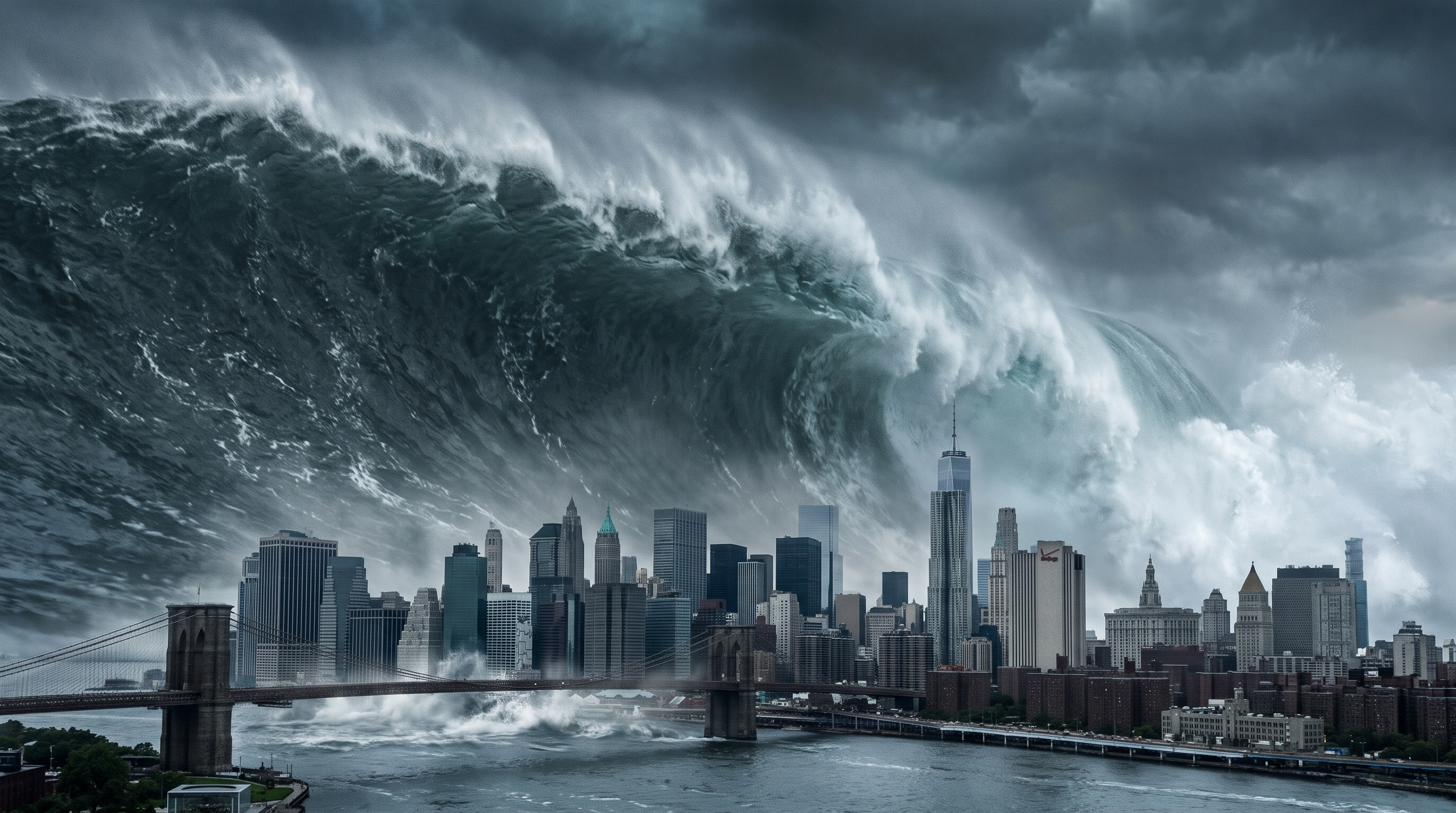
Earth’s climate is driven by continual planetary forces rather than a single static baseline, possessing a deeply complex history that long predates modern human industrialization. While human activities certainly generate greenhouse gases, the author argues that political attempts to control global temperatures are ultimately an unrealistic illusion of power. Instead of wasting vast resources trying to freeze the natural evolution of the planet, society should focus on proactive adaptation, much like our ancestors did through migration and technological innovation. By investing in resilient infrastructure, drought-resistant agriculture, and smarter habitat design, humanity can successfully navigate environmental shifts. Ultimately, surviving a changing world requires harnessing human ingenuity to harmonize with planetary forces rather than fruitlessly attempting to engineer them.
Having studied marine biology, marine geology, oceanography, plate tectonics, astrophysics, meteorology, mathematics, chemistry, genetics, sociobiology and ecology; taking that knowledge with me into the field and eventually carving out a career in Information Technology, I’ve applied my scientific understanding of the climate change debate as being far more complicated than the less knowledgeable political and media narratives suggest.
Earth’s climate has never been static. It could only be static if everything in the universe were to stop. Our Sun, carrying all the planets with it, corkscrews around the center of the Milky Way at approximately 827,000 miles per hour, constantly influenced by solar activity, celestial alignment, Moon’s orbit, Earth’s orbital mechanics and axial tilt, polar motion, volcanic activity, seafloor expansion and contraction, deep sea current circulation, mid-current friction, surface to air coupling, El Niño and La Niña, topological transformations, glacial cycles and the complex interactions between the atmosphere, oceans and biosphere.
Is your head spinning? Everything else is.
Consider the geological record. Approximately 15-20,000 years ago, enormous glaciers covered much of North America, and global sea levels were roughly 400 feet lower than they are today. Even on a geological timescale, the rapid sea-level rise driven by this deglaciation is astonishing—especially since it occurred long before human industrialization. In fact, if you zoom in on this time-line, you would be hard pressed to pinpoint the effects of industrialization in terms of sea-level rise.
The lower sea levels exposed vast areas of land, including the Bering land bridge connecting Siberia and Alaska. Homo sapiens were already migrating into the Americas, with ancestral populations using this northern route during the late Ice Age. As the glaciers retreated, coastlines changed, ecosystems transformed and new territories opened to human settlement.
CO₂ is part of this discussion, but it is not the entirety of it. Earth has experienced atmospheric concentrations of CO₂ ten times higher than today’s levels. Dinosaurs reached their masses due to explosive floral growth. Oceans absorb and release enormous quantities of carbon and heat. Hurricanes redistribute oceanic heat into the atmosphere and deeper waters. Saharan dust influences atmospheric conditions and can suppress hurricane development across the Atlantic. Even the Sahara, now one of the world’s largest deserts, was once a landscape of lakes, rivers, grasslands and abundant wildlife. Changes in Earth’s orbital mechanics and monsoon patterns helped transform it.
Don’t take a breath just yet. The average human generates approximately 347 lbs (0.347 metric tons) of CO₂ per year, making the global production of human CO₂ around 2.86 billion metric tons. Add to that every living organic organism and that number rises to approximately 860 billion metric tons of CO₂ per year. Putting this into perspective, human industrialization of fossil fuels contributes approximately 39 billion metric tons per year.
I have never heard a single politician say, or have I ever seen a protest sign that stated, STOP BREATHING / SAVE THE PLANET.
These examples illustrate the extraordinary complexity of our planet. Human activity can influence climate, and greenhouse gas emissions deserve scientific examination. But the notion that humanity can control Earth’s climate through political mandates, economic restrictions or ambitious environmental promises is another matter entirely.
We cannot reliably predict next week’s weather in every location, yet we routinely hear confident predictions about the precise climate conditions decades from now. Climate projections have scientific value, but they are not guarantees, and uncertainty must remain part of the conversation.
Here is where I believe our priorities have become misplaced.
Rather than devoting enormous resources to the political promise of controlling a planetary system that has been changing for billions of years, shouldn’t we be concentrating far more effort on adaptation?
Our ancestors did exactly that. During glacial advances and retreats, they migrated, developed new technologies, altered how they gathered food, built shelters, explored new territories and ultimately advanced human civilization. They didn’t attempt to stop the glaciers. They learned to live with a changing world.
We should be doing the same.
Build coastal communities intelligently. Improve flood protection. Develop drought-resistant agriculture. Manage water resources at the habitat design level. Design infrastructure for changing environmental conditions. Invest in energy technologies and engineering that improve human resilience. Use science and innovation to prepare for what comes next. There are vast areas of land and ocean where humans can adapt to live in.
All of us have stared out the window on a transcontinental flight only to think to ourselves, ‘Wow!, there is so much unoccupied land. I bet no one has ever stepped foot there.’
Don Davis Conceptual Art
We have the know-how and technology and I am all for the colonization of the solar system and beyond, but in the mean time, a habitat sixty feet down off the coast or a controlled community in death valley seems like a cake walk compared to colonizing the Moon or Mars.
Long before humanity can build a Von Braun Wheelin space, we need to practice this on land. The Saudis are doing just that with the LINE; the most ambitious project humanity has ever contemplated. This is a project that all the world’s wars could fund overnight and I would love to walk the LINE, in Neom, in my lifetime.
And let’s be honest: the idea that we can manipulate a planetary climate system to preserve today’s coastlines, protect every beachfront property, below-grade city and guarantee that our beach houses remain safe forever is a shill of politics.
Climate changes. It always has, and it always will, whether we are living on this planet or not.
Our responsibility isn’t to pretend we can hold the planet in check. It is to understand the forces shaping it, distinguish what we can influence from what we cannot, and use human ingenuity to adapt.
Aikido is a Japanese martial art, meaning, “The Way of Harmonizing Energy.” Rather than meeting an attack with opposing muscle, Aikido is built around redirecting linear forces and using inertia to unbalance the opponent. In its simplicity, Adaptation.
Our ancestors advanced civilization by adapting to a changing planet. Perhaps it’s time we rediscovered that lesson instead of believing we can engineer the planet to suit our preferences. Change got us here, Adaptation allowed us to remain.