If you’ve followed my posts over the years, you know my appetite for U.S. produced films—especially in the Sci-Fi genre–– has all but waned; it’s been a steady diet of reheated sequels, overcooked plots, and character development so thin you can slip them under a door. For that, I can get the same emotional dullness from the evening news.
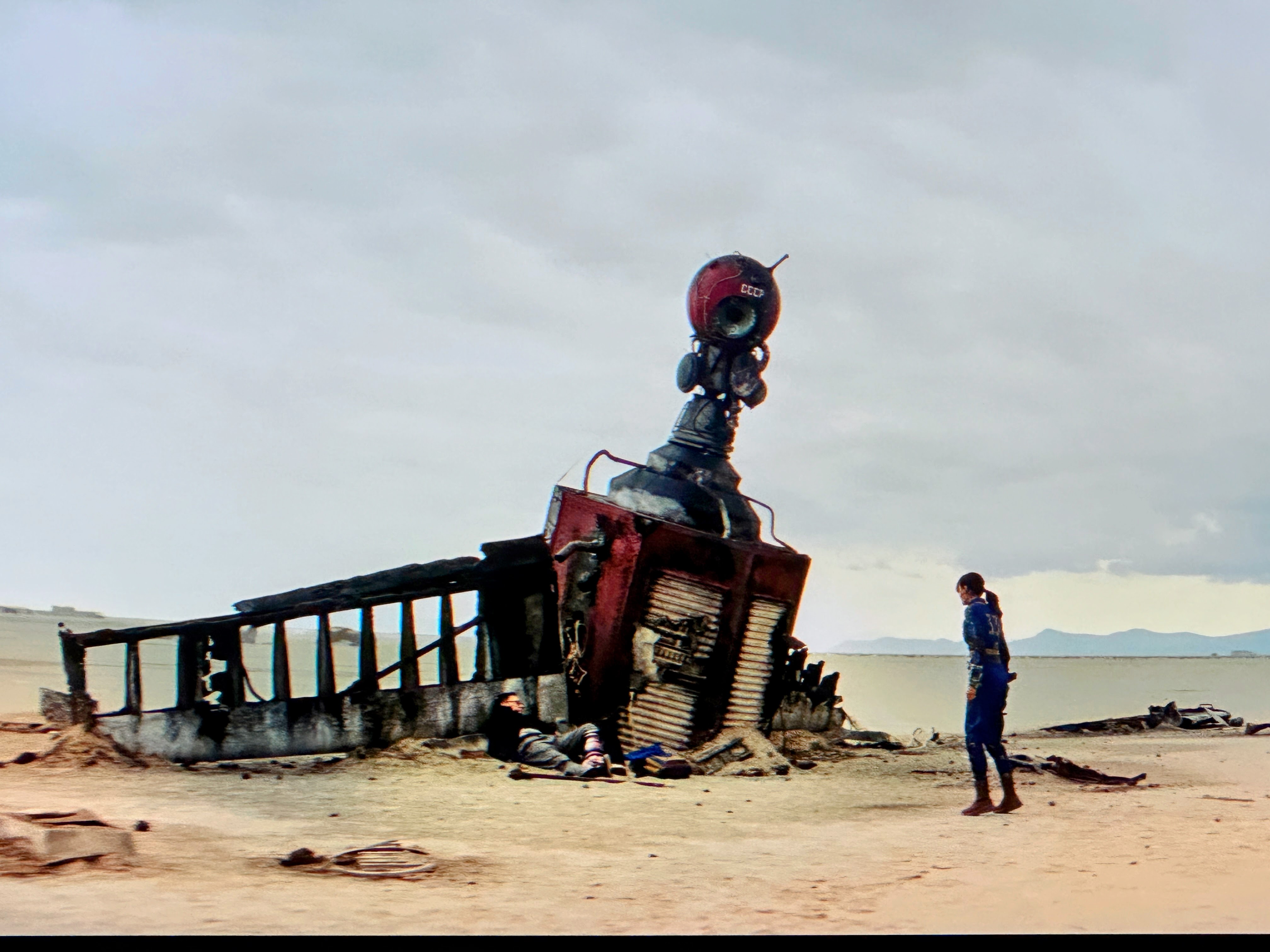
But Falloutis a breath of fresh, irradiated air. It’s a wild fusion of post-apocalyptic science fiction, western grit, mid-century nostalgia, and the stunning aesthetic similar of Simon Stålenhag. Think WOOL (Silo Series), by Hugh Howey, meets Asteroid City, with a dose of retro-futurism.
Adapted from the popular video game, the series opens in 1950s California at a picture-perfect birthday party—mid-century modern vibes and all—when suddenly, nuclear war breaks out. Fast forward to a devastated Earth where subsurface elites (pre-apocalypse California survivors) live in interconnected underground vaults. The plot kicks off with a trade between Vault 32 and Vault 33: one fertile man for a supply of crops, due to a blight that has wiped out Vault 32’s harvest. Naturally, everything spirals from there.
No spoilers, but the heroine from Vault 33 heads to the surface in search of her father—and that’s when things really get interesting.
While the characters span a colorful range, it’s the set design that steals the show for me. As a longtime fan of Simon Stålenhag, I found myself constantly pausing to take in the detail—each frame like a page from one of his eerie, beautiful picture novellas I love flipping through in the comfort of my living room, listening toBrian Eno.
When President John F. Kennedy stood before the nation in 1962 and declared that we would go to the Moon—not because it was easy, but because it was hard—he lit a fire that carried a generation into the stars. It was bold. Audacious. A promise that seemed impossible… until it wasn’t. Today, that spirit is alive again—but this time, it’s not coming from the Oval Office. It’s rising from the dust at Starbase Texas with Elon Musk.
As a kid, I’d lie in bed with a flashlight tucked under the covers, devouring Sci-Fi Pulp Fiction novellas long past bedtime. Back then, those glowing pages were portals—each word a beam of light teleporting visions straight into my mind. I saw moon bases, rocket ports, and human settlements scattered across the solar system. Those futures felt far-off but inevitable—like watching the first glint of dawn and knowing full daylight would follow. Not knowing then, I realized later that science Fiction is fact waiting to happen.
Now, that imagined future is solidifying into steel and launch pads on the Gulf Coast. Starbase, Texas—once a stretch of quiet shoreline—is transforming into the first entirely new city in decades, and more than that, it’s becoming the cradle of space colonization. Not just another launch site, but a functional city with its eyes pointed skyward. What once was fiction whispered to a child by flashlight is now a blueprint being built in daylight.
Most Americans haven’t quite absorbed this shift yet. The scale of it—what it means to have regular rockets, self-landing boosters, orbital refueling, and crews preparing to build on other worlds—still hovers just outside the public consciousness. But make no mistake: history will point to this moment and say, this is when it began. Not with flags planted in dust, but with concrete poured Texas and Florida, with dreams launched on reusable wings.
And Elon has managed to develop what feels like alien technology—without raiding the vaults of Area 51 or unsealing some forgotten Pentagon file. No secret spacecraft reverse-engineered from crash sites. No whispered hand-me-downs from shadowy defense contractors. Just the sheer force of vision, engineering, and iteration. It’s almost more unbelievable that way.
What we’re witnessing isn’t the result of hidden knowledge—it’s the result of someone who seems to think like an alien. A mind unbound by convention. While the aerospace establishment took baby steps, Elon sprinted past them, leapfrogging entire generations of tech. He didn’t wait for permission. He didn’t wait for NASA to go first. He moved fast, broke what needed breaking, and built a new space industry from the molten core of ambition.
In a way, Elon is our own alien developer—not from another planet, but from another mindset. He didn’t arrive in a saucer; he arrived with software updates and stainless steel prototypes. He doesn’t hide behind secrecy—he invites the world to watch. He tweets engineering problems. He launches Starships like we used to launch dreams.
The spacecraft we imagined hidden away in desert bunkers? He’s landing them upright on drone ships, catching them with chopsticks, naming them after science fiction AIs, and prepping them for Mars. And doing it all in plain sight.
Starbase, Texas, is not the endgame—it’s the launchpad for a civilization becoming interplanetary. A century from now, schoolchildren might look back and say: It didn’t come from aliens. It came from us. From a man who thought like no one else, and dared to build the future while the rest of the world waited for it to arrive.
This should be the most important 40 minutes shown in every classroom—a powerful antidote to the scrolling addiction that’s hijacking a generation’s focus, purpose, and potential.
Isaac Asimov’s The Robots of Dawn presents a vision of intelligent, humanoid robots integrated into society, raising questions about ethics, autonomy, and the boundaries between human and machine. Fast-forward to today, and we see real-world counterparts emerging in unexpected ways.
The, now, $1,000.00 Roomba, once seen as a novelty, now quietly symbolizes the normalization of domestic automation. For just a few hundred dollars, people can own a robot that navigates their homes, mapping spaces and cleaning autonomously — a concept that once seemed futuristic.
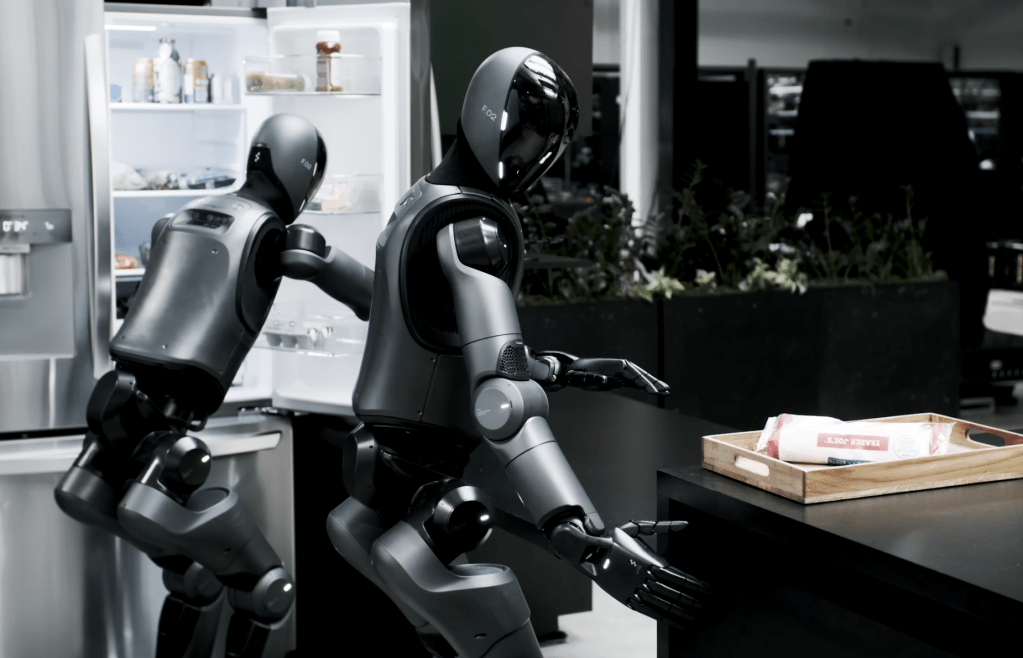
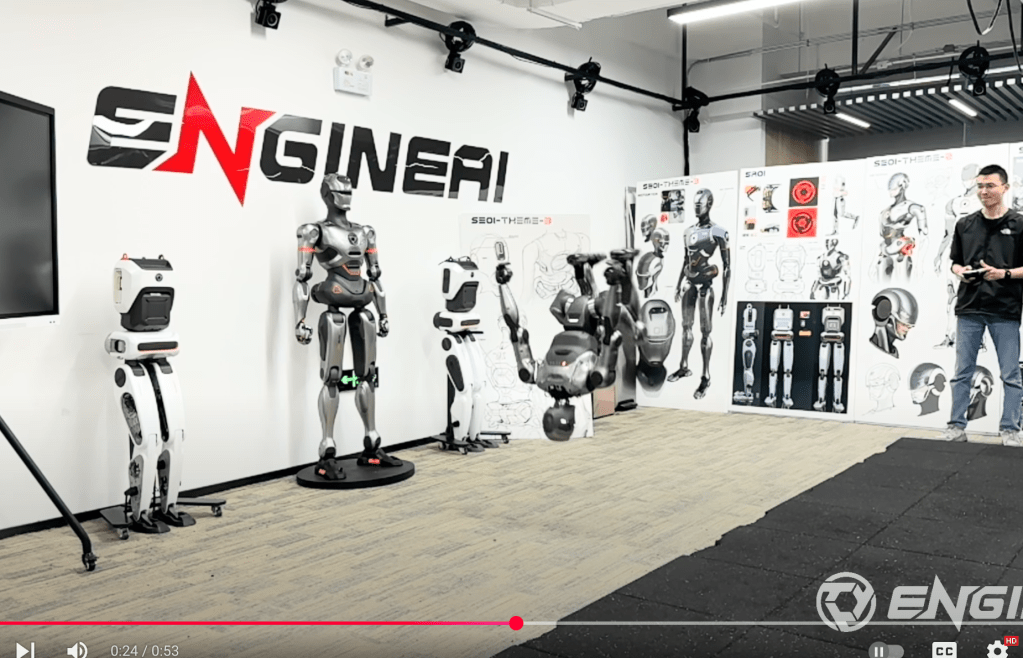
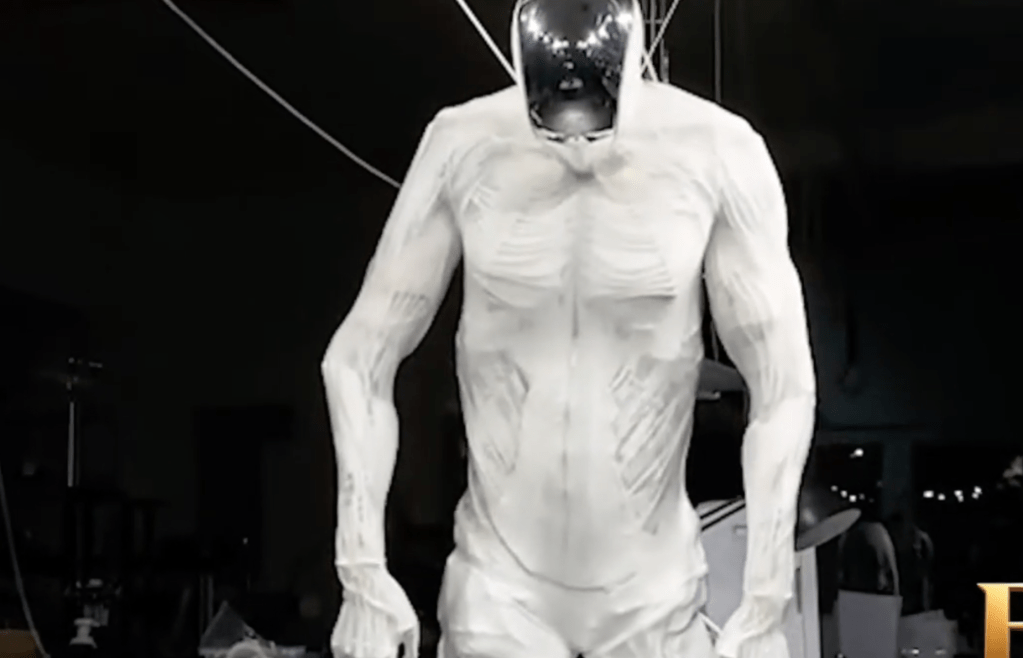
Tesla’s Optimus represents the next leap — a humanoid robot designed to perform complex physical tasks. This marks a shift from specialized automation to general-purpose robots capable of integrating into human environments. Recently, Tesla CEO Elon Musk made a startling claim that humanoid robots will surpass the human population by 2040, possibly over 10 billion robots. Sound preposterous? At first, but robots are not necessarily these metal and plastic devices, they come in the form of software (Alexa, Siri, Gemini, Grok, ChatGTP) or just an arm on a stand to make fries or flip burgers, clean up trash along roadsides, or carry things, clean, cook, pay your bills, etc. If you think this way, 10 billion might be conservative.
Meanwhile, in research labs and startup workshops, countless other robotic innovations are quietly taking shape — from automated delivery systems to caregiving assistants to military-grade drones. These developments, often overlooked until they reach mass adoption, can feel like a sudden wave of change.
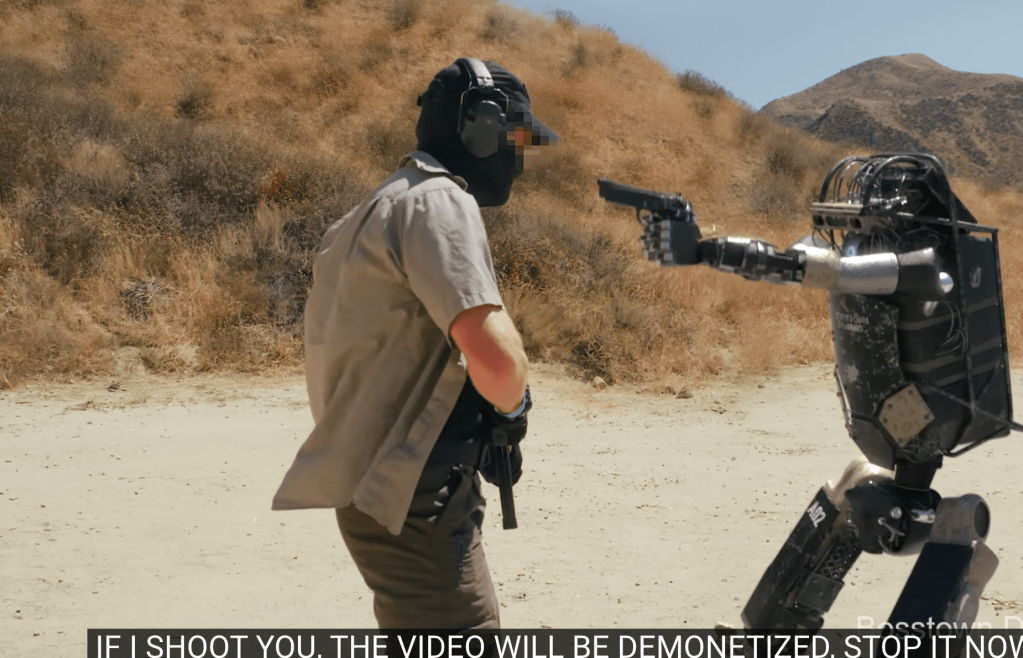
Then there is the military side of Robotics, and it looks disturbing. I cannot help but think of SkyNet, from the original Terminator. With Sci-Fi just being fact before it happens, this is something that actually worries me.
There are so many current Robotic developments occurring in the Military from robotic dogs with mounted machine guns, to legions of robots that can fight 24 x 7 to flying drones that hover and observe while others close in on a human target for detainment or termination.
The phrase “When did that happen?” captures this societal dissonance — the sense that technology often feels like it’s arriving overnight, even when it’s been brewing for years. Just as Aldous Huxley’s Brave New World depicted a society reshaped by science, we are witnessing an accelerating transformation that challenges our understanding of labor, privacy, and social dynamics.
So lets come back to the softer side and hope that Isaac Asimov’s Three Rules of Robotics hold true:
A robot may not injure a human being or, through inaction, allow a human being to come to harm.
A robot must obey the orders given it by human beings except where such orders would conflict with the First Law.
A robot must protect its own existence as long as such protection does not conflict with the First or Second Law.
But my bet is on the Adult Industry. Why? Well, the Adult Industry was the first industry to become profitable on the Internet. The Adult Industry has often been an early adopter — and sometimes the driving force — behind emerging technologies: The adult industry pioneered secure credit card transactions on the internet, driving early e-commerce innovation. Adult content creators were early adopters of VR technology, pushing hardware development and immersive experiences.
introducing Arya by Realbotix. While Ayra is marketed as a companion robot, her capabilities naturally extend to intimate scenarios. For individuals with social anxiety, physical disabilities, or those seeking companionship without emotional complexities, Ayra represents a deeply personalized solution. Although her current mobility is limited to a rolling platform, I don’t think it will be two many gens away from walking on her own.
Some may find this offensive, and like all emerging technologies there will always be the warped, the squeaky wheel that leaves a bad rep on this advancement. However, my thoughts are that what is lacking in the most advanced cutting edge of Robotics is the intimacy factor and I am not referring to sex, but the bedside manner. If history repeats itself, the Adult trade’s early adoption of Ayra-like robots could lead to breakthroughs in AI personality development, conversational depth, and emotional simulation. Over time, these advancements could reshape not only intimacy but also caregiving, mental health support, and social companionship. that can be adopted in the Healthcare industry for Healthcare, In-house care, Hospitals and Hospice.
There are certain pieces of music that trigger a person’s opiate receptors–– a channel opened–– only they can hear. For me, the performance of, In this Shirt by The Irrepressibles is just that… This performance is a collision of art and music, together of which are greater than the sum of its parts. This combination or artistic expression transcends space and time–– they do not merely coexist–– they intertwine, amplifying each other in a way that is both emerssive and transformative. This entanglement of color, vibrates like a chord creating a cosmic symphony where every living being, regardless of their location and form throughout the universe, perceives this moment in unison; sparking, perhaps, a universal consciousness, if even for a nanosecond.
Growing up in the 1950s, the idea of a future without flying cars seemed unthinkable. It was certain we’d see them in our lifetimes. Back then, images of flying cars leaped off the pages of pulp fiction, igniting dreams of airborne highways cluttered with assorted crafts, zipping along on raised avenues. Over the years, countless prototypes have emerged, yet most relied on fixed-wing designs that failed to revolutionize transportation.
Enter the Skyrider X1. At last, the concept of flying cars has become a reality. However, the true game-changer isn’t just the Skyrider X1 itself; it’s the infrastructure enabling its use—designated sites for liftoff and landing. This critical piece of the puzzle has long hindered the industry, which often focused too heavily on the product while neglecting the logistics necessary to support it.
Finally, someone has embraced the principles of Moshe F. Rubenstein’s The Minding Organization: identifying a purpose, assembling the right team, and working backward from the goal to achieve that vision. It’s a strategic approach that’s turning science fiction into everyday life.
Ask anyone if Time Travel exists and the vast majority of those asked will quickly tell you… No! Because they are looking to correct the past and the only direction that time travel exists in, is the future. So what is my proof? Well, I asked ChatGPT to summarize some of the earliest Sci-Fi novels that predicted the workings of the future: And the list was close to what I put together (I added references 8, 9 & 10.
The mere fact. I am using A.I. assistance is from Sci-Fi of the past (2001 A Space Odyssey).
And of course, I want to hear your proof that time travel does/does not exist, in either direction.
Jules Verne’s From the Earth to the Moon (1865) Verne envisioned a crewed mission to the moon nearly a century before the Apollo 11 mission. Although his ideas on how the journey would be achieved differed (he suggested a giant cannon), the concept of space exploration and moon landings was well ahead of his time.
Mary Shelley’s Frankenstein (1818) Shelley’s novel imagined the reanimation of dead tissue using science and electricity. While the exact scenario remains fictional, her exploration of bioengineering, organ transplantation, and the ethics of life creation foreshadowed modern fields like genetic engineering and bioethics.
Edward Bellamy’s Looking Backward: 2000-1887 (1888) Bellamy’s story imagined a utopian future society with features like credit cards, shopping malls, and a system resembling universal healthcare, many of which resemble modern developments in consumerism and public services.
H.G. Wells’ The War of the Worlds (1898) While The War of the Worlds is about an alien invasion, Wells speculated about advanced technology, including heat rays (which could be likened to lasers) and chemical warfare, both of which would later become real.
Hugo Gernsback’s Ralph 124C 41+: A Romance of the Year 2660 (1911) Gernsback, sometimes called the “Father of Science Fiction,” imagined technologies like radar, television, and solar energy. While his narrative is less well-known, these inventions were groundbreaking in concept at the time and became real within decades.
Arthur Conan Doyle’s The Lost World (1912) Though not about the future per se, Doyle’s novel introduced the concept of exploring remote areas with unknown flora and fauna, which presaged real-life discoveries of species and ecosystems deep in the Amazon and other secluded regions. This can also be linked to modern biodiversity research and conservation.
E.M. Forster’s The Machine Stops (1909) This short story foresaw a world where people live in isolation, communicating through screens, with most services automated by a vast technological network. The eerie resemblance to the internet, social media, and even video conferencing makes Forster’s work uncannily prescient.
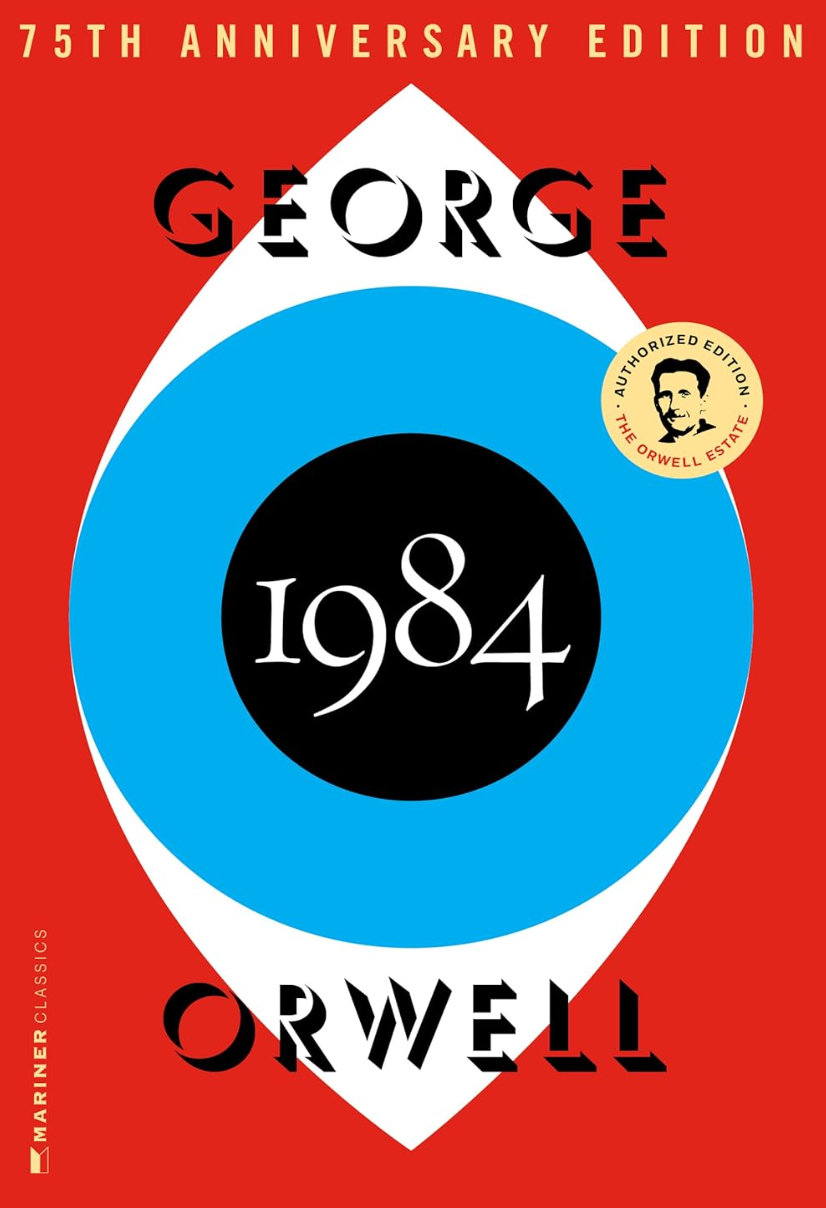
George Orwell’s 1984 (1949) Orwell’s 1984 envisions a dystopian future where totalitarianism is taken to an extreme, with constant surveillance, government propaganda, and strict control over personal freedoms. Many concepts from the novel, such as Big Brother, Thought Police, and Newspeak, now feel strikingly familiar in an era of mass surveillance, data collection, and media manipulation. Technologies and practices Orwell describes, like surveillance cameras, facial recognition, and even censorship, are in effect in various forms worldwide. His work has often been cited in discussions about government overreach, privacy rights, and digital surveillance in the modern age.
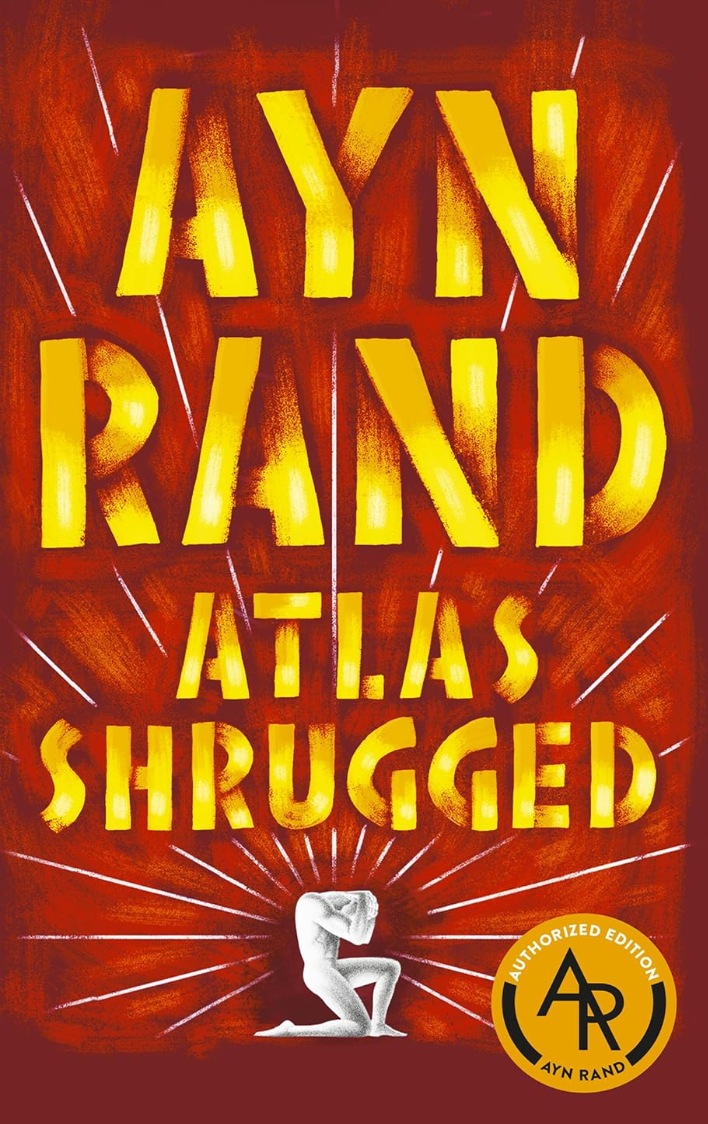
Ayn Rand’s Atlas Shrugged (1957) Rand’s Atlas Shrugged presents a world where government intervention and regulation stifle innovation, leading to economic collapse and the eventual exodus of society’s most productive and creative individuals. While not a direct prediction, Atlas Shrugged resonates with real-world debates about government regulation, free markets, and the role of individualism versus collectivism. Concepts like entrepreneurial burnout, over-regulation, and the idea of “going Galt” (named after John Galt, a central figure in the book who withdraws his talents in protest) are themes that have found new life in discussions of government policy, innovation, and economic freedom.
Arthur C. Clarke’s 2001: A Space Odyssey (1968), which he developed in parallel with Stanley Kubrick’s iconic film, is one of the most prescient science fiction works in terms of technology and space exploration. Clarke predicted or inspired several technological advancements that later became reality:
Artificial Intelligence (AI) and Voice Recognition The story’s AI, HAL 9000, is an intelligent computer capable of natural language processing, decision-making, and even emotions. HAL anticipated the development of AI systems like Siri, Alexa, and advanced voice recognition. Although HAL’s sentience and emotional intelligence remain fictional, modern AI and natural language processing have achieved many of the interactive functions Clarke imagined.
Tablets and Personal Screens The film depicted astronauts using flat, tablet-like devices to watch news and gather information. This closely resembles the modern tablet, and companies like Apple and Samsung have created devices nearly identical to those imagined by Clarke and Kubrick. In fact, Apple referenced 2001: A Space Odyssey during its patent dispute with Samsung, pointing out how the film showcased tablet-like devices decades before the iPad was invented.
Commercial Space Travel 2001 envisions a future where commercial flights to space are routine, with a space station orbiting Earth and a shuttle taking travelers to a lunar base. While routine space travel for civilians hasn’t yet reached this level, we’re seeing a new era of commercial space travel with companies like SpaceX, Blue Origin, and Virgin Galactic making strides toward space tourism and lunar missions, bringing Clarke’s vision closer to reality.
Video Calls The movie showed video calling (such as when Dr. Floyd talks to his daughter from space), a concept that seemed futuristic at the time. Today, video calls are commonplace on platforms like Zoom, FaceTime, and other video conferencing apps, making this one of Clarke’s more immediate predictions to come true.
Space Stations and Moon Bases Clarke’s vision included a rotating space station and the prospect of human settlements on the Moon, both of which became more plausible after the Apollo missions. The International Space Station (ISS) functions as a multi-national, rotating habitat much like the one depicted in 2001, though on a smaller scale. Plans for permanent lunar bases are currently under development through programs like NASA’s Artemis mission.
Suspended Animation (Cryosleep) Although still in the realm of science fiction, Clarke’s concept of astronauts in suspended animation for long journeys remains an area of scientific interest. Researchers are actively exploring ways to extend human hibernation or stasis for long-duration space travel.
As you can see, all one needs to do is read Science Fiction to know that Time Travel into the future exists. Science Fiction is simply fact waiting to happen. And what better example of Time Travel into the future than looking at our current political climate. This election cycle was perhaps the most looked upon, global election of our time. The outcome of which will create U.S.A. 2.0. But I am going to leave that snippet for a later post and get back to time travel into the future, but as it relates to this election cycle.
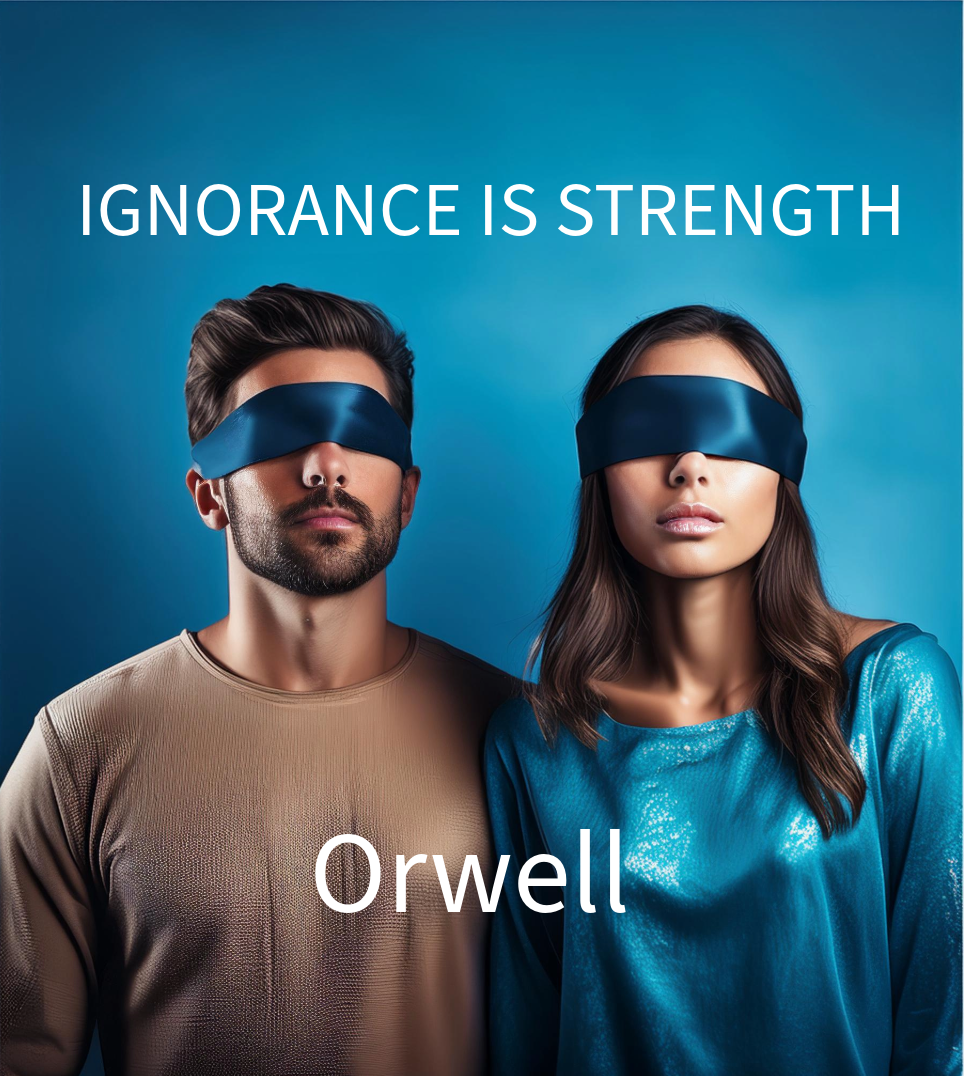
Probably the most notable Science Fiction is George Orwell’s 1984. In a quick flyby. it involves a government over-reach (Oceania), a Super State in a constant war that may or may not exist, to corral it’s society in fear and distraction of Big Brother. Why this is not a mandatory read in our current educational system is because it was being played out in real-time. But with recent events in our political climate, in this version, Winston Smith will prove out that 2 + 2 does equal 4.
And what better, equally powerful, read than by Ayn Rand, because I can’t think of a more controversial figure who predicted the future so accurately. And what more controversial work of hers, but Atlas Shrugged. Read this snippet of Atlas Shrugged:
“I don’t know what it is that they think they accomplish—but they want us to pretend that we see the world as they pretend they see it. They need some sort of sanction from us. I don’t know the nature of that sanction—but, Dagny, I know that if we value our lives, we must not give it to them. If they put you on a torture rack, don’t give it to them. Let them destroy your railroad and my mills, but don’t give it to them. Because I know this much: I know that that’s our only chance.” She had remained standing still before him, looking attentively at the faint outline of some shape she, too, had tried to grasp. “Yes . . .” she said, “yes, I know what you’ve seen in them. . . . I’ve felt it, too—but it’s only like something brushing past that’s gone before I know I’ve seen it, like a touch of cold air, and what’s left is always the feeling that I should have stopped it. . . . I know that you’re right. I can’t understand their game, but this much is right: We must not see the world as they want us to see it. It’s some sort of fraud, very ancient and very vast—and the key to break it is: to check every premise they teach us, to question every precept, to—”
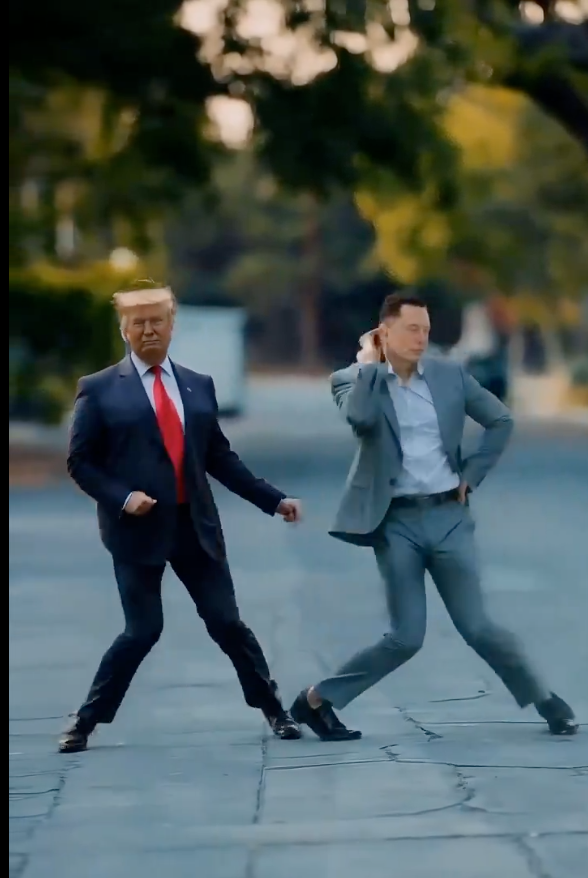
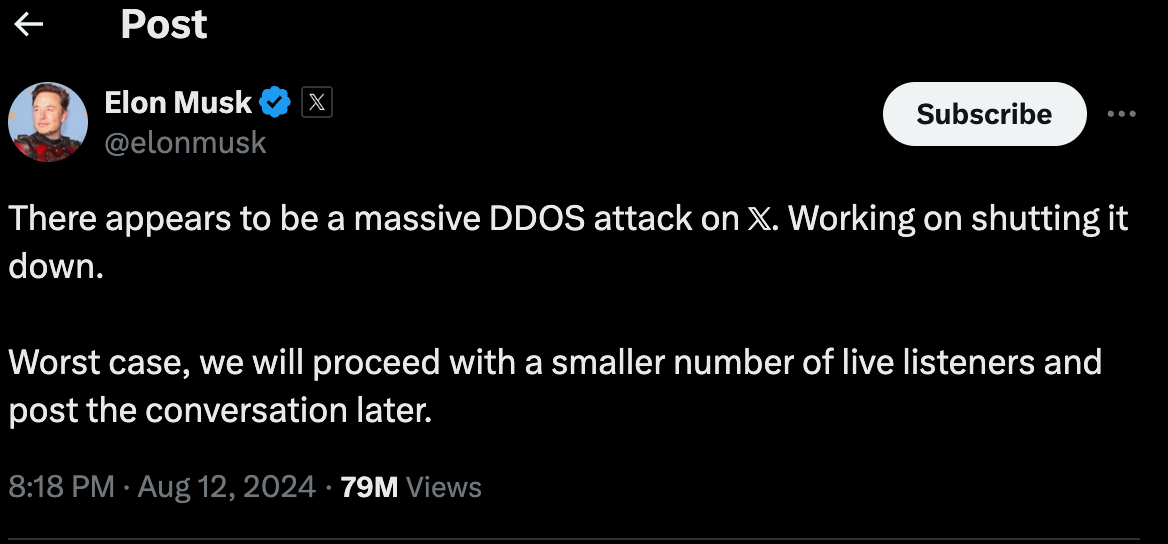
The night of August 12th 2024, I think the world caught up to Science Fiction: The Musk/TRUMP interview. It was set to start at 8:00 PM ET on the X platform. I logged in and made a bee line to Elon’s feed and tried to join the space, but in doing so the platform froze…
As a career IT professional, with an expertise in enterprise monitoring–– having the ability to know what are inside the data packets and where they came from, I suspected a DDoS (Distributed Denial of Service) attack by the machines of opposition, bent on bringing down this particular X space for fear of an awakening. Very Orwellian. It was later determined that a DDoS attack was at play here.
The DDoS was doing its job and seeing I was not able to join this space I jumped over to YouTube and searched for “Musk-TRUMP interview” and found a live feed I could lamprey onto it. They too were having issues but the narrators were keeping the 251K of us lampreys on their feed up to date. They were hearing Trump’s mic but it was faint and cutting in and out. I kept this tab opened and jumped back to X and searched for TRUMP’s feed. BINGO! I was in. The DDoS attack was focusing on Elon. But by then, the team at X had isolated the DDoS sources and held off the attack.
I kept jumping back and forth between platforms and found, like myself, thousands were lampreying off other live feeds wherever they could and these numbers were well in to the seven digits. So there were a lot of unaccounted sessions for the live stream and then take into account the recorded event listened to afterwards, shared and viewed. The totals, that the opposition doesn’t want you to know, will be into the hundreds of millions.
There is no going back from here for the line in the sand has been crossed, where wars of the future will be fought online and you will be notified as to when and what termination station you are assigned.
Of all the events I have witnessed over the years, I feel this event was up there with the moon landing, played out in cyberspace with a message that was clear– The future is exciting for those brave enough to see it. I’m sure this event rocked the Ministry Of Truth and you can already see the expected NewsSpeak not carrying this link while counter-playing the effect it had. They will focus on the X platform having glitches, a rambling conversation, their fact checking, but not on the overall message to the world and how many tuned into it. Long live the Winston Smiths!
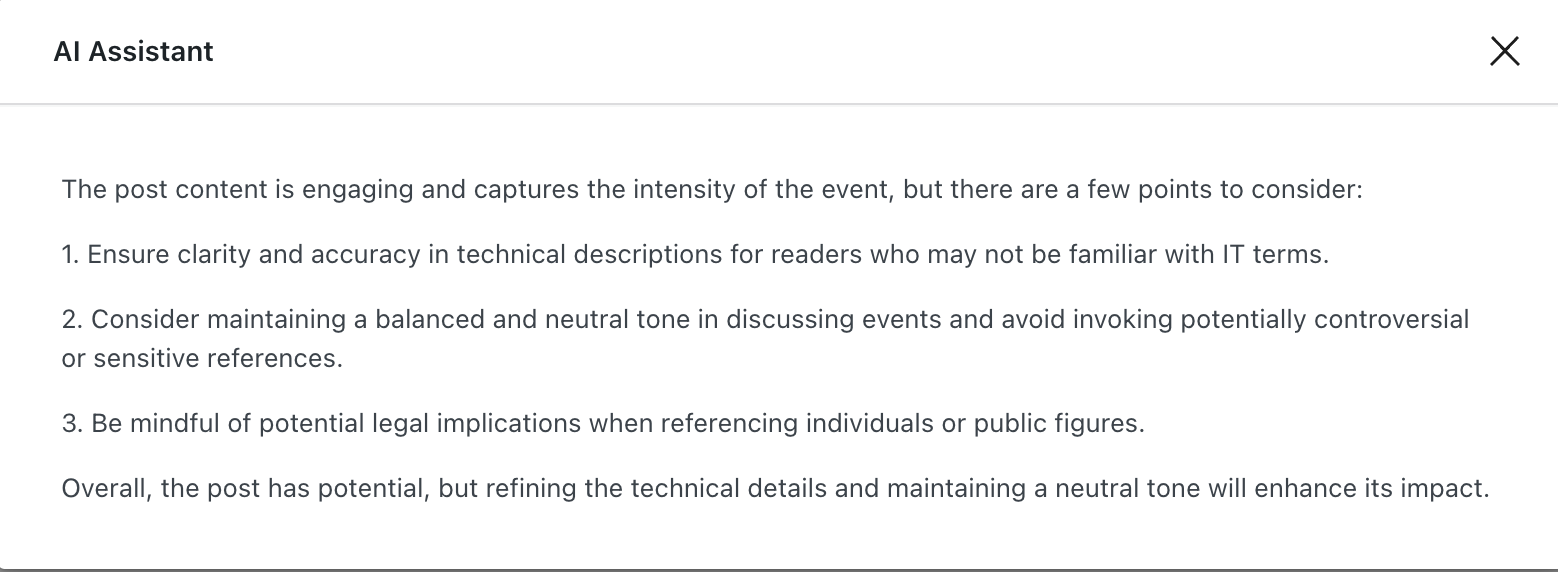
P.S. When I used WordPress’s AI Assistant to provide feedback of my post (which is fantastic by the way) I was warned about the legalities and sensitive information Big Brother is everywhere.
As a writer of science fiction, I draw inspiration from the silent mentors of my past: George Orwell, Ayn Rand,Ursula K. Le Guin, and others. Like all writers of fiction, I hope to pass on something I have said that others will use as a compass for themselves.
Reading George Orwell’s 1984 for the first time in the 70’s was pure fiction to me at the time, but like all Science Fiction they are just facts not yet experienced. Getting older is thought to be a curse, but the curse is seeing more clearly than when in youth. You can’t ignore the past and expect a miracle outcome, only a failure to trip over it later in life.
Some of my favorite notable quotes from these authors:
“The further a society drifts from truth the more it will hate those who speak it” – George Orwell
“The people will believe what the media tells them to believe” – George Orwell
“We can evade reality but not the consequences of evading reality” – Ayn Rand
“There is no difference between communism and socialism, except in the means of achieving the same ultimate end: communism proposes to enslave men by force, socialism – by vote. It is merely the difference between murder and suicide” – Ayn Rand
“Lying is the misuse of language. We know that. We need to remember that it works the other way round too. Even with the best intentions, language misused, language used stupidly, carelessly, brutally, language used wrongly, breeds lies, half-truths, confusion. In that sense you can say that grammar is morality. And it is in that sense that I say a writer’s first duty is to use language well” – Ursula K. Le Quin
“Injustice makes the rules, and courage breaks them” – Ursula K. Le Quin
I came across a fascinating read on BBC.com about fake newspaper companies in the US, which are owned and operated out of Russia; their objective? To spread misinformation. Yes, nothing new here, but read between the lines, where Sci-Fi Writers gather their ideas and see the future in the rear-view mirror.
“In the year 2224, the world is a place where truth and fiction have become indistinguishable, where society has been nursed for a century on fabricated posts, altered histories, and manipulated facts.
Every aspect of one’s life is dictated by the “Feed,” a global entity of tailored information to each individual, creating personalized realities. People live in isolated bubbles of perception, their beliefs shaped by an algorithm designed to maximize engagement rather than truth.
Enter O, who stumbles upon a hidden cache of unaltered records from the 21st century. As O delves deeper into these relics of the past, he begins to see the stark contrast between then and now. Driven by a desire to uncover the truth, O forms a clandestine group called “VeriFire” who are determined to burn down the Feed through its own memes.”
The other morning I was invited by a friend, who each Monday he and a crew finds a quiet little breakfast place to catch up and solve the worlds problems.
What I noticed among the facts presented to support a statement or argument came from posts presented on their smartphones: unquestioned, unvetted, untrue…. We have all seen this among among our own friends and family, but I can no longer keep up on their education of seeking out the truth before propagation begins.
If this is where we are now, how can A.I. prevent the speed of false information if A.I. is the source?
For every mousetrap their exists a smarter mouse.
But there just might be a profound effect when we approach the fork in the road. Will the weight of disinformation become so heavy that humanity will sink beneath its own wisdom or will a primitive allele, a safety mechanism for survival, be awakened where the truth will prevail and the Feed is reduced to ashes? DNA might be slow to replicate in comparison to algorithms, but genes passing the baton to their memes is a cleaver one. While the Algorithms are focusing on their Adversary (DNA), the memes will be flying under the radar.
Start by awakening your friends and family to unveil the truth before propagation.
This is my most anticipated film of all time. The Challenge. A Russian made film (started in 2021) and the world’s first feature-length Science Fiction-Drama that was filmed (partially) in space with actors, by the professional filmmaker, Klim Alekseevich Shipenko. Although not the first film to ‘use’ scenes shot in space; this is exceptionally different. The actual footage presented in the movie is around 30-40 minutes. The rest of the film was shot on Earth. The film crew and actors were in orbit for approximately two weeks.
The film stars Yulia Peresild – A Russian Stage Actress, Singer and Cosmonaut– the first professional actress in Outer Space! The film also carries two well known actors: Miloš Biković and Vladimir Mashkov.
The viewing collected more than 1 Billion Rubles in 13 days (about 10.9 million) –– the most ever for an opening day, grossing over 2 billion Rubles on a 905 Million Ruble budget, which is to say… impressive.
The story is about a Earthbound Surgeon sent to the ISS to perform surgery on an injured Cosmonaut, too ill to return to Earth.
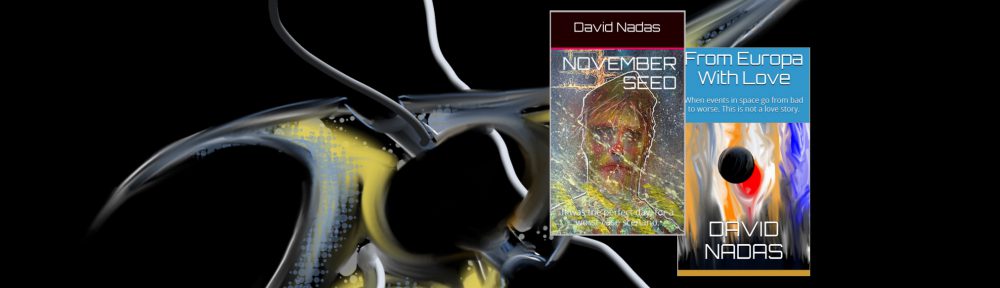

 David Nadas