The Chrono-Christmas Glitch

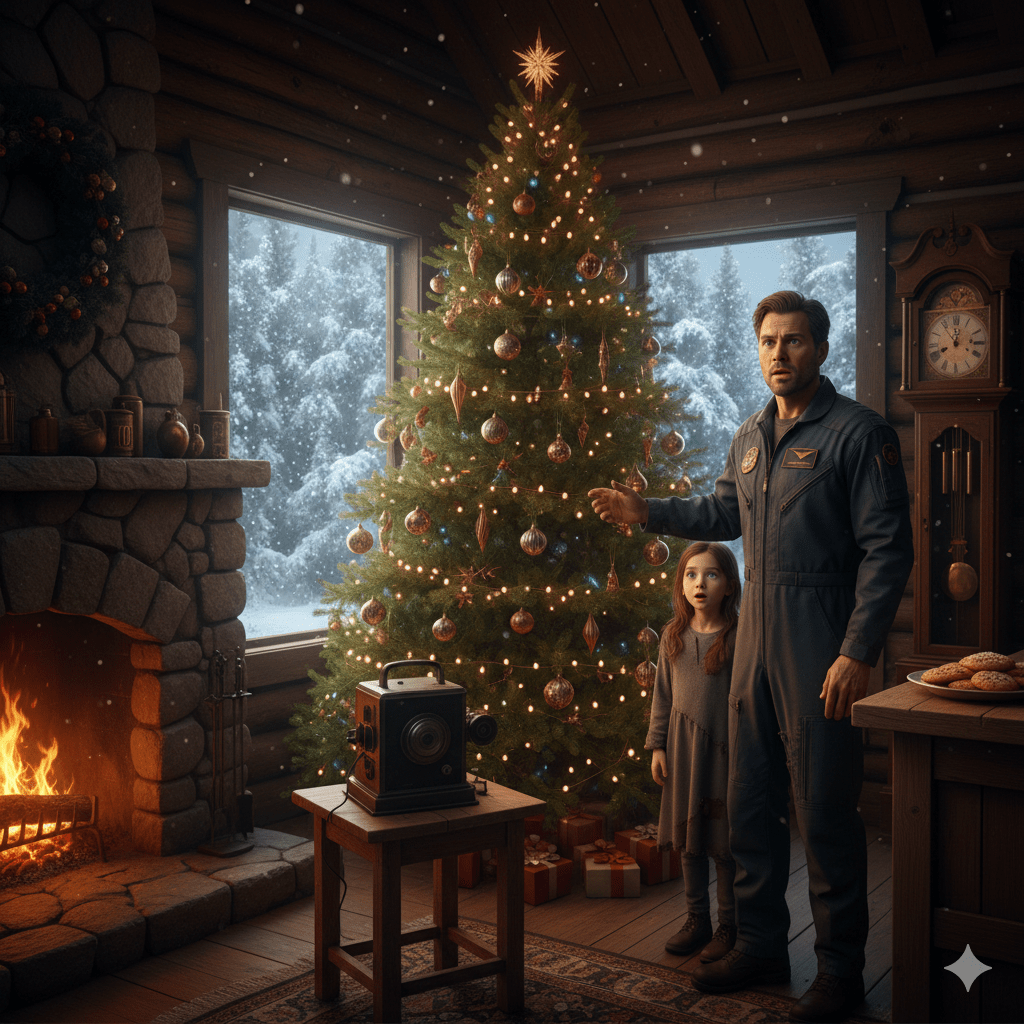
Image generated by Gemini

The neon pulse of New Tokyo felt colder than usual as the artificial snow—a byproduct of the city’s atmospheric scrubbers—drifted down like almond slivers onto the metal walkways. The city, a colossal sprawl of chrome and carbon, hummed with the ceaseless rhythm of a million lives under perpetual twilight. Each hab-unit, a tiny cell in the vast hive, offered its occupants a fleeting illusion of privacy, a fragile shield against the overwhelming scale of their existence.

In the corner of a cramped hab-unit, barely larger than a maintenance pod, Kael sat before a flickering holographic projector. It wasn’t showing the latest data-streams or hyper-ads, nor the endless loop of manufactured entertainment that usually filled the void. Instead, it displayed a grainy, centuries-old image of a pine tree, impossibly green, that glitched to the point of turning into stipple before it dissolved. The resolution was poor, the colors fading in and out, but to Kael, it was a window to a forgotten world.

“Is that it?” a small voice asked, full of innocence and curiosity. Rin, Kael’s daughter, leaned in, her small face illuminated by the emerald light of the projection, her eyes wide with wonder. She had only ever seen the sterile, metallic landscapes of New Tokyo.

“That was a Christmas tree,” Kael said, pulling her close to his side, his voice rough, raspy from the recycled air that circulated through their sealed environment. “Back when the seasons changed on their own, and trees grew from the ground, not in climate-controlled bio-domes.” He pointed to a faint shimmer in the projection. “Those are decorations, called ornaments. And the bright bits? Those were tiny lights. And through the windows, real snow fell all through the night, making everything sparkle when the sun rose the next morning.”

He reached into the pocket of his worn flight suit, a relic from his days as a deep-space hauler, and pulled out a small, round object. It was a genuine orange—a luxury item, a forbidden fruit smuggled in from the orbital hydro-farms, costing more credits than a month’s oxygen scrip. He peeled it slowly, the sharp, sweet, citrus scent a potent, almost forgotten aroma, cutting through the metallic tang of the station’s recycled air.

“Daddy,” Rin said, her eyes still fixed on the holographic tree, a thoughtful frown creasing her brow. “Can the projector… can it bring back the smell of the tree?” She sniffed the air, as if trying to conjure the scent from the pixels themselves. “And… and the snow? The real snow! Can I feel it?”

Kael chuckled softly. “Oh, little star, if only I could. The projector can show us images, sounds sometimes, but to bring back a scent… that’s a different kind of tech and I would need a lot more power and upgrades–– and at that, it would not be the real scent of the tree.”

He handed a slice to Rin. As she tasted the fruit of an Earth she would never see, a world that existed only in fragmented data-logs and faded projections, the distant hum of the fusion reactor outside their window seemed to fade, replaced, just for a moment, by the faint echo of a choir.

“Merry Christmas Eve, Rin,” he whispered, brushing her hair aside, watching her savor the alien sweetness.

He tinkered with the old holographic unit, a scavenged piece of pre-collapse tech he’d lovingly restored. He’d often pushed its limits, extracting every ounce of its archaic magic. He adjusted a dial, intending to enhance the image, but as his fingers brushed a loose wire, a jolt coursed through the unit, and a blinding flash erupted from the projector.

The hab-unit dissolved around them. The metallic walls, the flickering neon, the distant hum of the reactor—all vanished in a dizzying blur of light and color. It felt like they’d slid into a hyper-jump, but not across vast interstellar distances. Instead, they plunged through layers of time, through forgotten memories and echoes of a world long gone.

When the light faded, the air was suddenly thick with the scent of burning wood and something else, something sweet and warm. The sterile, recycled air was replaced by a crisp, cold breath that carried the unmistakable aroma of pine. Kael blinked, his eyes adjusting.

They were no longer in their cramped hab-unit. They were in a rustic log cabin, its walls made of rough-hewn timber. A stone fireplace dominated one wall, a cheerful fire crackling within, casting dancing shadows across the room. Though the windows, fat, fluffy snowflakes drifted lazily down onto the sills, the grove beyond, blanketed with sleeves of snow on their branches. Real snow.

On a worn wooden counter in the corner, a platter of golden-brown cookies sat cooling, their aroma of cinnamon and sugar almost overwhelming. A large, bushy evergreen tree stood proudly in the center of the room, adorned with strings of bright, colorful lights and shimmering glass ornaments.

Rin gasped, her eyes wider than Kael had ever seen them. She stared at the tree, then at the fire, then at the snow falling outside. “Daddy,” she whispered, her voice barely audible. “I can smell the … the tree… The snow!” she shouted, running to the window, her breath fogging the cold glass pane.

Kael could only stare, his mind reeling. The air was colder, fresher, invigorating. He reached out, his hand passing through the warm air emanating from the fireplace, feeling the radiant heat on his skin. This wasn’t a projection. This was real.

A grandfather clock in the corner chimed softly, a deep, resonant sound that vibrated through the cabin, marking a time that was, and yet, somehow, now. They had fallen, not through space, but through time, landing in a Christmas of a forgotten past.
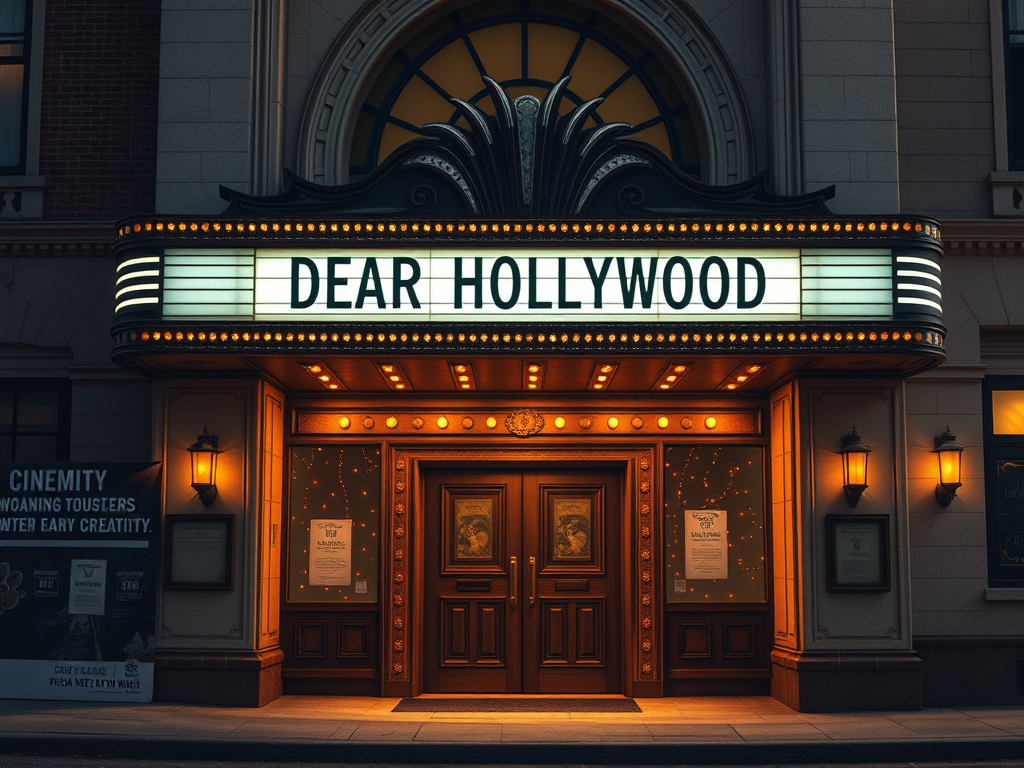
Hollywood’s Storytelling Crisis: A Call to Action

Once upon a time, the world looked to you for dreams. Your stories lit up the dark. You taught us to hope, to fight, to love bigger than we ever thought we could. You drew us into the theaters–Heck! My first real job, at fifteen, was that of being an usher at the Algonquin Theater in Manasquan, NJ, wearing a suit several sizes too big, where my pants were belted up around my rib cage and I could stick my hand out the fly to collect tickets. I didn’t care, I loved watching the movies, over and over again. I know a part of my love for storytelling had its roots watching the dreams that came out of Hollywood, but somewhere along the way, you started recycling the dream.

Let’s be clear: the issue isn’t foreign productions undercutting you with cheaper labor or tax incentives. This isn’t about money—this is about meaning. While you’re too busy crunching box office projections, pushing agendas or polishing another paint-by-numbers sequel to a storyline so predicable, so superficial, the rest of the world is blistering by you, telling stories that feel alive.

Look around. South Korea delivers genre-bending tales that slip between social commentary and character drama without blinking. Scandinavian series dig deep into human darkness and come back with something honest. Indian filmmakers are blending myth and modernity with unapologetic flair. Even small indie studios are crafting intimate, resonant stories that travel the globe without a cape or a sequel.

What do you offer in return?

Another reboot. Another origin story. Another climax telegraphed halfway through Act One. Your scripts seem to be engineered by advertisers, your characters one ticket stub short of an influencer, your endings are a fast food big meal to placate the mindless couch polyps–– It’s not just predictable—it’s anesthetic.

The real loss is that you’ve trained audiences to expect less and you truly think we are stupid and are less. And now, those same audiences are quietly, steadily, turning to other voices. Not because they’re louder, but because they’re real. I would rather slug through an Amazon Prime series interrupted by brainwashing commercials than go see a Hollywood dumpster fire.

We know the risk is higher when a story doesn’t follow the template. But that’s what made you great in the first place. You took risks. You shattered norms. You redefined what cinema could do. So why now are you so afraid of silence, of slowness, of substance? You used to bulldoze through the walls of social pressure—now you’re just another face in line, submitting to pat-downs for the soulless dystopian junk you helped create.

Hollywood, the world still wants stories. But now, it’s learning to look elsewhere.

Wake up. Or keep fading into your own formula. You are so hell bent on protecting Intellectual Properties, thinking that A.I. is your greatest threat. Your greatest threat is not seeing that A.I. is your greatest asset.

Sincerely,
A Storyteller Who Still Believes in Magic—Just Not Yours Anymore.

PostMortem

If you’re hunting for storylines, give me a ring—I’ve got enough to defibrillate the flatline diagnosis you’re mistaking for cinema.

Is gaming a waste of time? No.

Anyone who has spent time with me discussing technology or science fiction knows that one of the most influential books I’ve ever read is Snow Crash (1992) by Neal Stephenson. For me, it was a trailblazer, lighting the way to ideas often overlooked by mainstream thinking. For anyone entering the field of information technology, it’s like a guidebook for imagining the future. But, amusingly, very few of the people I’ve urged to read Snow Crash ever actually did—much like when someone says, “You really should read the Bible…”

I doubt even Stephenson–– when he finished writing this novel–– fully anticipated the profound impact his work would have. Beyond laying out the blueprint for the internet, coining future-defining phrases, such as the Metaverse (Facebook’s Meta)…, defining concepts of franchising a culture, and inspiring entire gaming platforms (i.e. Second Life, World of Warcraft, etc), Snow Crash set the stage for a wave of sci-fi novels and films that followed his vision.

But for me, one brief passage in the book sparked a truly unconventional view: it led me to question our so-called “addiction” to screen time—or, as I like to call it, glassed. The hours people spend immersed in digital worlds aren’t necessarily wasteful or detrimental; instead, they offer new avenues for creativity, connection, and exploration. This, however, is a perspective I rarely succeed in convincing others of. My audience often hears me out, their interest piqued at first, only to be overwhelmed by new ideas before they drift away, defaulting back to familiar doubts about technology’s role in our lives.

Stay with me on this, and if you can”t, just scroll to the bottom and watch the trailer, then come back to this part of the post:

The protagonist in Snow Crash, Hiro, encounters Da5id. In real life, Da5id is a quadriplegic, but in the Metaverse, he is a formidable presence—a “bad-ass” who moves freely and with authority. His character exemplifies how people can adopt powerful, alternate personas in digital spaces, unconstrained by their physical limitations in the real world. I think why this resonated with me much as it did, may have had a lot to do with the character, Da5id (sounds a lot like David), who opened my eyes to a world I had thought of as just play, until I heard his story.

If you have ever spent time in an MMO (Massive Multiplay On-line game), you can easily loose your concept of time as well as who you really are. In these MMO platforms, you adopt an Avatar to represent you in the digital world, like putting on a cowboy hat or crown as a kid and the alter-ego you became. I myself have never submerged in one long enough to dive into the abyss, but those who have, like Hiro, just may have had a better life in the digital world then the one, limited by flesh and blood.

At parties, if I am lucky enough to be in the company of others who bring up the inevitable: “The real problem with this world is that people are spending too much time on their phones...” This is where I cast the line and with just the right amount of jigging, I set the hook…. but more often I loose my catch before reeling one in. If you have ever seen a fish with a hook set in it’s jaw, as I have, the first thing you notice are the glassing of the eyes–– they are only thinking of escape, like my audience. LOL.

But too my point and before I loose my catch, I highly recommend you watch this amazing NetFlix documentary called, The Remarkable Life of Iberlin, before it is gone. Then afterwards, we can have that conversation. Thank you , as always, for your time.

A film that would make Yuri Gargarin Smile

This is my most anticipated film of all time. The Challenge. A Russian made film (started in 2021) and the world’s first feature-length Science Fiction-Drama that was filmed (partially) in space with actors, by the professional filmmaker, Klim Alekseevich Shipenko. Although not the first film to ‘use’ scenes shot in space; this is exceptionally different. The actual footage presented in the movie is around 30-40 minutes. The rest of the film was shot on Earth. The film crew and actors were in orbit for approximately two weeks.

The film stars Yulia Peresild – A Russian Stage Actress, Singer and Cosmonaut– the first professional actress in Outer Space! The film also carries two well known actors:  Miloš Biković and Vladimir Mashkov.

The premiere was held on World Cosmonautics Day, (April 12th, 2023) which coincided with the 62nd anniversary of the first human spaceflight by Soviet cosmonaut Yuri Gagarin, (April 12th 1961) at the State Kremlin Palace in the Moscow Kremlin.[8]

The viewing collected more than 1 Billion Rubles in 13 days (about 10.9 million) –– the most ever for an opening day, grossing over 2 billion Rubles on a 905 Million Ruble budget, which is to say… impressive.

The story is about a Earthbound Surgeon sent to the ISS to perform surgery on an injured Cosmonaut, too ill to return to Earth.