Mystic Men

It seems like OMD’s song “Maid of Orleans” and how it might have been overlooked is not uncommon; many significant events, whether in music, art, or other fields, can sometimes be overlooked or not receive the recognition they deserve in their time.

When I heard this song back in 1981, I was living in Noank, CT with my best friend, George (God rest his Soul). We were different in many ways but loved the same music. Whenever I listen to this song, I am transported back to that small town, living hand to mouth, opting to ride my bicycle to work to save on gas (~$1.35/gal) and spending what little we earned on music and drinking at Chucks until closing, failing miserably to pick up girls. But in our defense, I don’t think it was us, personally. You see, we smelled like fish 24×7, having worked at Mystic Aquarium. But wandering home from Chucks, four-sets of taillights in our vision, we left our “ducks” on the front porch, where even the stray cats stayed away from our boots. After a shower and change of clothes, one of us would slip on a white glove and remove an album from our collective stash then spin music finto the late morning (for medicinal reasons).

Excerpt from “Mystic Men” (WIP)

In memory of George “Gil” Lavigueur – Sept. 27, 1957 – May 13th, 2012

My best friend

The day everything began to unwind,the color of the water around Fort Wetherhill in Jamestown, RI was a Payne’s Grey.  I remember that because it was the same color as the sky and there was no horizon line for either.   To say it was cold that morning was an understatement.  The sky felt as heavy as lead and If the cove had remained still for even a minute it would have frozen over.  

I remember it being the first day of January because we had just celebrated 1981 the night before, closing Chucks as usual. Leaving alone as usual, not remembering how we got home, as usual.

Diving was a great way to work off a hangover and while the recreational diver was at home on a day like this, drinking their coffee in front of the fireplace and watching reruns of Jacque Cousteau, George and I were about to enter the water on the western side of the hill. We were the real deal; Marine Biologists making $10,000 a year before taxes.  We stopped off at a coffee shop on the way, ordering two black coffees, each; one for us the drink, the other to pour into our wetsuit just before we entered the water…..
I Saw The Light

One of my greatest failures in life turned out to be one of my greatest achievements.

It was during my first semester in college, pursuing my love for the ocean and my goal of becoming a Marine Biologist, that I signed up for a course called Ecology. I thought it would be a breeze compared to my other courses; after all, it was just about littering and such, Right? However, on the first day of class, the professor set a high bar by challenging us to pick any living thing and write about its most limiting factor. With that, she left the room, and the class was over before I knew it – an easy course, or so I thought, giving me enough time to hit the surf before my next class.

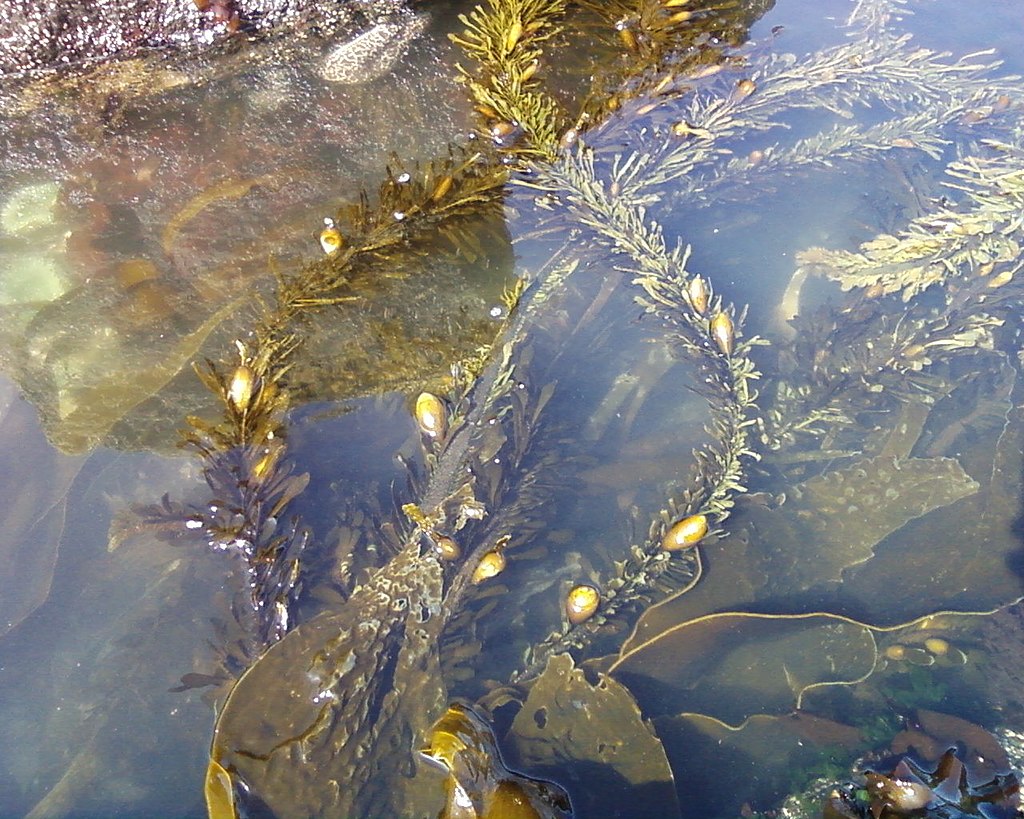
Back in those days, there was no Internet, and it wouldn’t arrive for another decade and a half. So, I headed to the University Library, where I could do some research. My fascination with seaweed led me to read countless abstracts and books on Phycology – the study of seaweed. One day, I stumbled across a 1976 abstract by Robert Black, titled “The Effects of Grazing by the Limpet Acmaea Insessa on the Kelp Egrecia Laevigata in the Intertidal Zone.” This was it – bingo. I delved deeper into the geology of the substrate where Egrecia grew, and I read abstracts on water chemistry, kelp’s holdfast mechanisms, the average wave surge on the kelp canopy, the current patterns off the Monterey Peninsula, the grazing habits of the limpet, as well as the rate of growth of the giant kelp and its Achilles heel – its holdfast.

I typed up a ten-page abstract using an IBM Selectric and even had to buy my own ink ribbon. At the end of my research, it was clear to me that the major limiting factor of Egrecia laevigata was the Limpet, Acmaea insessa.

Excitedly, I handed in my work, feeling like Ralphie in “A Christmas Story,” trying to hold back a grin that was worthy of receiving a Nobel Prize.

However, the next class, I received my paper back with an “F” grade and a single word circled in red (Light). It was a blow that felt like it could be heard around the world.

I failed Ecology that semester, but with a smile because it opened a receptor in my brain not used before.

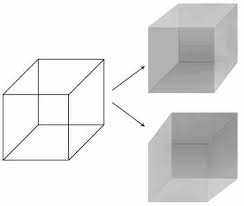
I was determined to retake that course, but unfortunately, the same professor wasn’t teaching it for another year, so I had to wait. Finally, the next year, when she saw me sitting in the front row, she nodded at me with a look that suggested I might be a glutton for punishment. But I was a new person, and I aced the course. I owe much to her for making me pause and think before reaching a conclusion. During that year, I developed a new approach, which I dubbed the Necker Cube Approach – that every problem has at least two correct resolutions, one being more correct than the other based on the objectives surrounding it.

Years later, I had the opportunity to attend a lecture by M. Rubenstein titled “The Minding Company,” based on his observations and philosophy that design should be looked at from the end to the beginning. It is the way Apple designs its products as opposed to the way Microsoft does. What hit me was that it was, in a way, the Necker Cube approach.

Since then, I have been applying the Necker Cube approach throughout my career. Sadly, I left the field I loved (Marine Biology) for a much more lucrative one in Computer Science, but witnessed the birth of personal computing and the rise of the internet and beyond.

Despite my career path change, all is not lost., for I blend both careers into my science fiction writing, incorporating the Necker Cube, but in this case, as a quantum gateway to anywhere in the universe.