“Crime Is Down” – Or Have We Just Closed our Beaches?

As a writer of Science Fiction, I share the blame with my fellow writers for stories written about a dystopian future, but the idea of writing science fiction is fueled by what we feel the future holds.

We keep hearing that crime statistics are down–much better than they were in the 1950s, that kids are “statistically safer” than ever. But let’s put this into perspective:

In the 1950s, kids walked to school alone. Rode bikes across town on busy streets. Played in parks until dark. Went trick-or-treating for hours unsupervised. They left the house at 7:00 AM, in the summer, and their only obligation was to be back by dinner. There were no cell phones to get in touch with them and no game plan as to what they were doing or where they were going.

Today they are chauffeured everywhere, tracked by phone and never out of range from adult helicoptering. So when someone says “child abductions are down,” I think: Of course they are—we’ve essentially put kids under house arrest.

That’s like closing all the beaches and announcing “Shark attacks are at historic lows!” Well, yeah. There’s no opportunity for attack when nobody’s in the water.

The same logic applies across the board:

  • Burglaries down? We have Ring cameras, alarm systems, and never leave our doors unlocked.
  • Street crime down? People don’t walk places anymore—they drive everywhere.
  • Assault down? We avoid whole neighborhoods and stay inside after dark.
  • Car jacking is down: Cars have 360 degree cameras with recorded footage, alarms and can be shut off remotely. No one leaves their keys in the cars with the windows opened like they did in the 1950’s. Heck, keys were an “option” to starting the engine.

We haven’t made society safer. We’ve made ourselves smaller. We’ve adapted to danger by surrendering freedom—building higher fences, installing more cameras, restricting our movements, and never letting our kids experience the independence we once had.

The statistics don’t show we’ve solved the problem. They show we’ve accepted defeat and learned to live in a cage we pretend is normal.

When you have to fundamentally change your behavior to avoid becoming a statistic, the danger didn’t decrease—you just stopped showing up in the data.

This makes for great Sci-Fi writing… so thank you all.

The Glow Economy

“In A World”

When the power went out, the walls kept breathing light. Some called it a miracle. Others called it hunger.

The sun had long set, leaving the world outside in an inky blackness that modern humanity had all but forgotten. But inside the compact, carefully insulated home, a soft, ethereal blue-green light pulsed gently from the kitchen.

This wasn’t the stark, instant illumination of electric bulbs, but something far more ancient and alive: bio-lumitech.

Electricity, once the invisible omnipresent hum of civilization, had become a precious, rationed commodity. The great grids had failed, and while emergency power flickered for essential services, everyday homes had turned to ingenious, sustainable alternatives. One of the most beautiful and widely adopted was the cultivation of living light.

As the last sliver of orange drained below the horizon, a different kind of magic began to unfold outside. Along the pathways and thoroughfares, the streetlights didn’t flicker on with a mechanical click. Instead, a slow, deep blue glow began to emanate from their globes. These weren’t traditional glass casings, but transparent spheres filled with nutrient-rich water, harboring dense colonies of bioluminescent plankton—a genetically cultivated strain of dinoflagellates.

The poles themselves were no longer inert metal, but living structures, or at least structures designed to mimic life. Each streetlight pole was engineered with an internal network of capillary tubes, functioning like artificial xylem. These tubes continuously drew up fresh water from a ground, using a passive, wicking action similar to how trees pulled moisture from the earth. This steady, gentle flow kept the plankton’s watery environment fresh and oxygenated, preventing stagnation and ensuring their constant, healthy glow throughout the night. It was a marvel of bio-mimicry, making the very infrastructure of the city a part of the living light cycle.

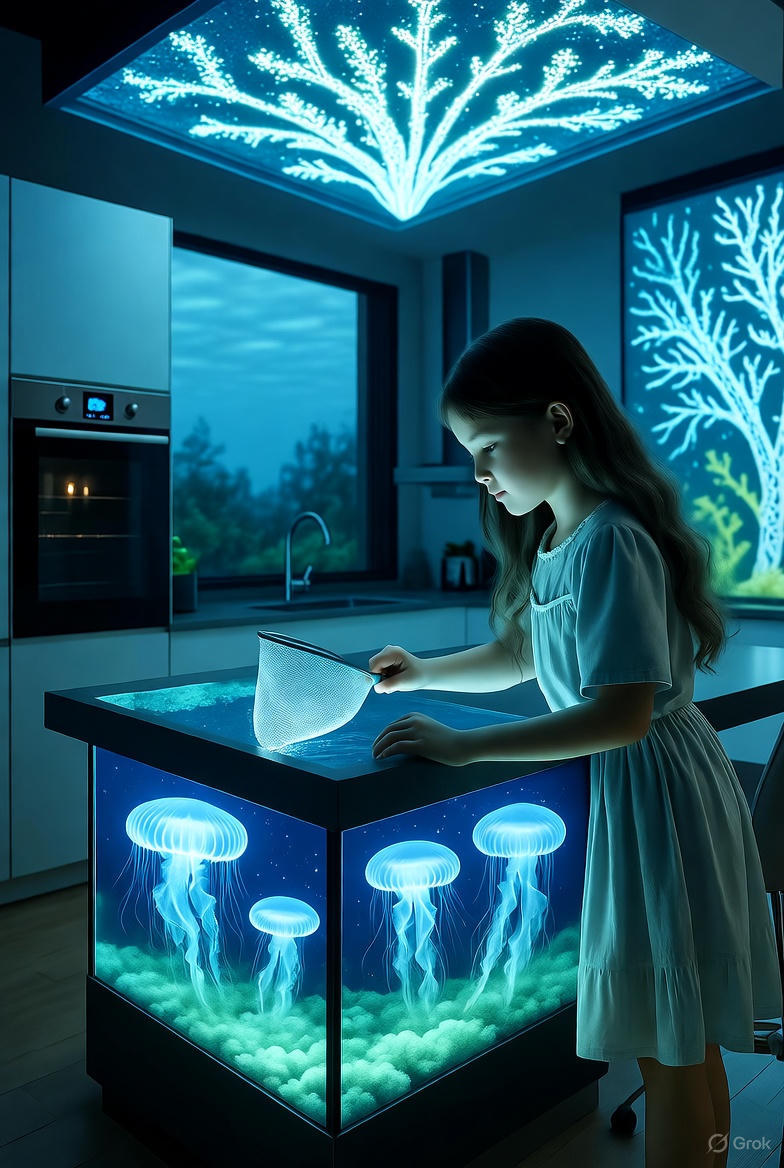
In the heart of the home, the kitchen, ten-year-old Lyra stood by a large, transparent tank, her brow furrowed in concentration. The tank, roughly the size of a small bathtub, wasn’t for washing dishes; it was the family’s primary light source, a thriving colony of bioluminescent jellyfish. These weren’t the wild, stinging creatures of the ocean, but a specially engineered, hardy species affectionately known as “Lumen Jellies.” They pulsed with a gentle, internal rhythm, their bell-like bodies contracting and expanding, releasing tiny bursts of cool light that danced off the tank’s curved walls.

Lyra, with her small, nimble fingers, was performing the delicate ritual of seeding a new bloom. This wasn’t just a chore; it was a science, passed down from her grandmother, a vital part of their family’s survival and comfort. Her task today was to introduce a fresh batch of polyp clones into the main tank, ensuring a continuous cycle of light production.

Beside her, a smaller, clear container held the nascent life: minuscule, almost invisible polyps clinging to a ceramic lattice. With a specially designed, wide-mouthed pipette, Lyra carefully siphoned a nutrient-rich solution containing the tiny, developing jellies. She released them gently into the main tank, watching as they drifted downwards, seeking purchase on the established substrate.

“You have to be patient, little ones,” she whispered, her voice soft against the gurgle of the aeration pump. “Grow strong. Your light keeps us safe.”

The family didn’t kill the jellyfish for their light. Instead, the Lumen Jellies had been bred to periodically release microscopic, light-emitting proteins – a natural overflow of their bioluminescent capabilities – into the tank’s water. Every few weeks, Lyra’s father would use a fine-mesh filter to collect this luminescent protein solution.

This solution, once harvested, would be carefully mixed with a sterile biogel – a clear, nutrient-rich medium designed to keep the proteins active and glowing. With specialized brushes, her mother would then apply this shimmering biogel to the family’s lumen-lined walls. These walls weren’t painted; they were embedded with a subtle, porous matrix that absorbed and held the biogel, allowing it to slowly release its gentle, living light for days or even weeks.

The effect was utterly transformative. The walls of their home glowed with a dynamic, living luminescence, stronger in some patches, softer in others, mimicking the natural ebb and flow of moonlight through leaves. It cast no harsh shadows, but rather diffused everything in a soft, welcoming embrace. Reading by the kitchen’s warm hum, or gathering for dinner under the bedroom’s more subdued shimmer, was an experience steeped in connection – to the living organisms that provided their light, and to a resourceful humanity that had found beauty in scarcity.

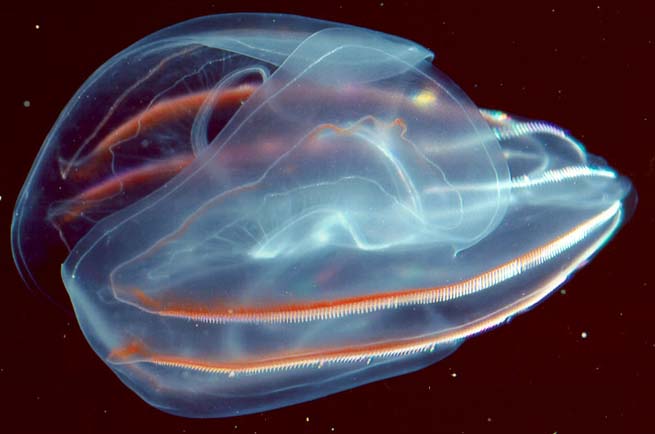
Outside, the roadways glowed, the lanes lined in a bluish-green glow, where cars run on biofuel roll silently, their autonomous tech using the gridlines to keep everyone safe and in their lanes. Along the roads were homes, their light gardens shimmering like the combs of Ctenophores, the windows emanating a soft light keeping the skies above so clear comments could be seen with the naked eye.

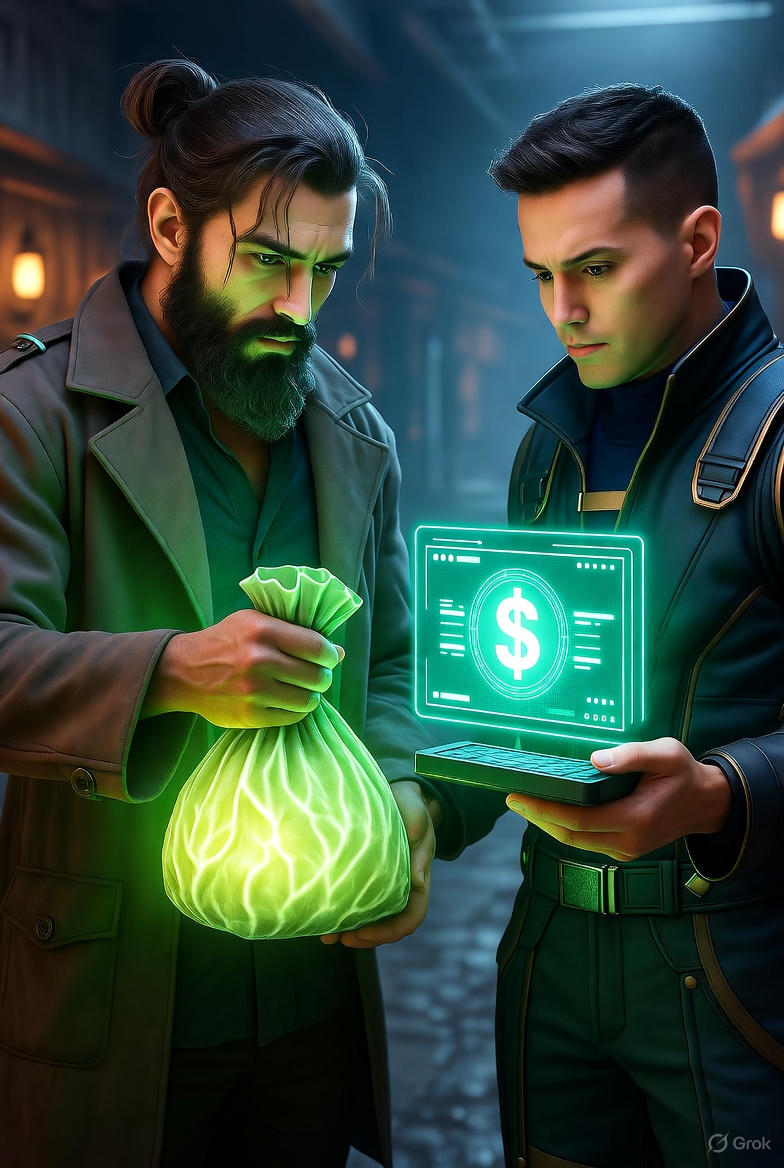
Not far away, in the underbelly of urban life, an encrypted black market deals in pure, stolen luciferin precursors. These aren’t for novelty; they are the chemical fuel for the forbidden Chromatic Strains—genetically engineered organisms that pulse with colors tied directly to the owner’s mood or the hour of the day. Here, the predatory live vicariously through the consciousness of others.

Transactions are strictly off-grid, settled with untraceable crypto, shielding the identity of the wealthy elite who fund this obsession. Like the rarest, cutthroat orchid hunts of the 1920s, these living lights are the ultimate status symbol, signaling wealth and access to restricted tech. They are the new darlings, dazzling and deadly, and securing a unique, stable strain is genuinely worth killing for.

It is estimated that 12% – 15% of the electricity produced on this planet goes to lighting. Think about that. We can keep rolling out solar panels that collect sunlight, convert it into direct current where it is passed onto Inverters that feed the grid and……. well…. turn electricity back into light. Why not just cut out the middle man and create art. Bioluminescence is chemiluminescence — light produced by a chemical reaction inside an organism.. No sunlight is needed. The light comes from a reaction between:

  • Luciferin – the light-producing molecule
  • Luciferase – the enzyme that catalyzes the reaction
  • Oxygen – which reacts with luciferin to emit photons

Is it possible we are blind to everything? To what we have and haven’t had to think about it. What if we could tap trees for solar energy? They would be the land analog of bioluminescent creatures — living organisms as light factories. Going from Photosynthesis (Capturing light) to Bioluminescence (Creating light) to Bioelectricity (Transducing light into current). If we could do this, think of how humans would, once again, see forests or a single tree.

The Efficiency

Bioluminescent reactions are astonishingly efficient — up to 90% of the energy goes into light, not heat. Compare that to a candle or incandescent bulb, which wastes ~95% as heat.

About the author: David Nadas – “Where Science meets Storytelling”

Growing up at the Jersey Shore, summer nights were pure magic. The air was still and the dark water surface looked like a mirror, reflecting the stars above. As our 14′ outboard glided out through the canals and the Manasquan Inlet to the ocean, the reflection created an illusion of being suspended in space–– stars both above and below our hull. We positioned ourselves just far enough out to still see the distant glow of oceanfront homes and the kaleidoscope of colors from the boardwalk amusement park. Jumping into the water was the final thrill: every kick and arm movement set off a brilliant flash of bioluminescence from the plankton, igniting the water like heat lightning. These experiences were what led me to study Marine Sciences and my fascination of bioluminescence has never faded.
3 Ships built per day, 1000 per year

When President John F. Kennedy stood before the nation in 1962 and declared that we would go to the Moon—not because it was easy, but because it was hard—he lit a fire that carried a generation into the stars. It was bold. Audacious. A promise that seemed impossible… until it wasn’t. Today, that spirit is alive again—but this time, it’s not coming from the Oval Office. It’s rising from the dust at Starbase Texas with Elon Musk.

As a kid, I’d lie in bed with a flashlight tucked under the covers, devouring Sci-Fi Pulp Fiction novellas long past bedtime. Back then, those glowing pages were portals—each word a beam of light teleporting visions straight into my mind. I saw moon bases, rocket ports, and human settlements scattered across the solar system. Those futures felt far-off but inevitable—like watching the first glint of dawn and knowing full daylight would follow. Not knowing then, I realized later that science Fiction is fact waiting to happen.

Now, that imagined future is solidifying into steel and launch pads on the Gulf Coast. Starbase, Texas—once a stretch of quiet shoreline—is transforming into the first entirely new city in decades, and more than that, it’s becoming the cradle of space colonization. Not just another launch site, but a functional city with its eyes pointed skyward. What once was fiction whispered to a child by flashlight is now a blueprint being built in daylight.

Most Americans haven’t quite absorbed this shift yet. The scale of it—what it means to have regular rockets, self-landing boosters, orbital refueling, and crews preparing to build on other worlds—still hovers just outside the public consciousness. But make no mistake: history will point to this moment and say, this is when it began. Not with flags planted in dust, but with concrete poured Texas and Florida, with dreams launched on reusable wings.

And Elon has managed to develop what feels like alien technology—without raiding the vaults of Area 51 or unsealing some forgotten Pentagon file. No secret spacecraft reverse-engineered from crash sites. No whispered hand-me-downs from shadowy defense contractors. Just the sheer force of vision, engineering, and iteration. It’s almost more unbelievable that way.

What we’re witnessing isn’t the result of hidden knowledge—it’s the result of someone who seems to think like an alien. A mind unbound by convention. While the aerospace establishment took baby steps, Elon sprinted past them, leapfrogging entire generations of tech. He didn’t wait for permission. He didn’t wait for NASA to go first. He moved fast, broke what needed breaking, and built a new space industry from the molten core of ambition.

In a way, Elon is our own alien developer—not from another planet, but from another mindset. He didn’t arrive in a saucer; he arrived with software updates and stainless steel prototypes. He doesn’t hide behind secrecy—he invites the world to watch. He tweets engineering problems. He launches Starships like we used to launch dreams.

The spacecraft we imagined hidden away in desert bunkers? He’s landing them upright on drone ships, catching them with chopsticks, naming them after science fiction AIs, and prepping them for Mars. And doing it all in plain sight.

Starbase, Texas, is not the endgame—it’s the launchpad for a civilization becoming interplanetary. A century from now, schoolchildren might look back and say: It didn’t come from aliens. It came from us. From a man who thought like no one else, and dared to build the future while the rest of the world waited for it to arrive.

This should be the most important 40 minutes shown in every classroom—a powerful antidote to the scrolling addiction that’s hijacking a generation’s focus, purpose, and potential.

Hollywood’s Storytelling Crisis: A Call to Action

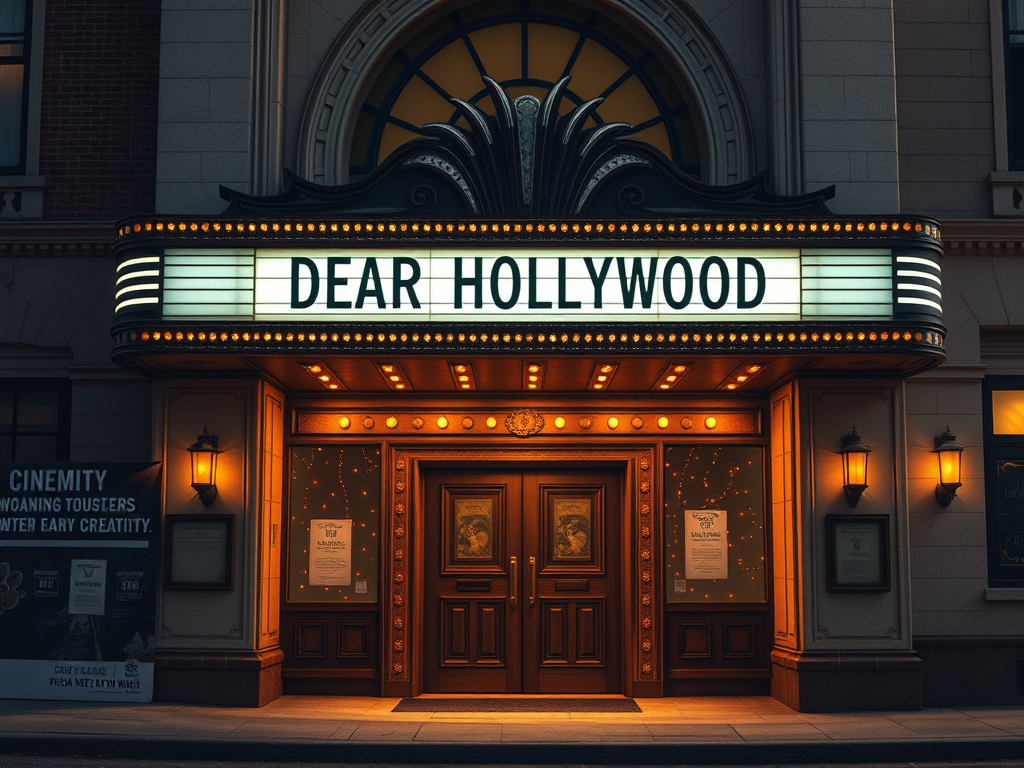
Once upon a time, the world looked to you for dreams. Your stories lit up the dark. You taught us to hope, to fight, to love bigger than we ever thought we could. You drew us into the theaters–Heck! My first real job, at fifteen, was that of being an usher at the Algonquin Theater in Manasquan, NJ, wearing a suit several sizes too big, where my pants were belted up around my rib cage and I could stick my hand out the fly to collect tickets. I didn’t care, I loved watching the movies, over and over again. I know a part of my love for storytelling had its roots watching the dreams that came out of Hollywood, but somewhere along the way, you started recycling the dream.

Let’s be clear: the issue isn’t foreign productions undercutting you with cheaper labor or tax incentives. This isn’t about money—this is about meaning. While you’re too busy crunching box office projections, pushing agendas or polishing another paint-by-numbers sequel to a storyline so predicable, so superficial, the rest of the world is blistering by you, telling stories that feel alive.

Look around. South Korea delivers genre-bending tales that slip between social commentary and character drama without blinking. Scandinavian series dig deep into human darkness and come back with something honest. Indian filmmakers are blending myth and modernity with unapologetic flair. Even small indie studios are crafting intimate, resonant stories that travel the globe without a cape or a sequel.

What do you offer in return?

Another reboot. Another origin story. Another climax telegraphed halfway through Act One. Your scripts seem to be engineered by advertisers, your characters one ticket stub short of an influencer, your endings are a fast food big meal to placate the mindless couch polyps–– It’s not just predictable—it’s anesthetic.

The real loss is that you’ve trained audiences to expect less and you truly think we are stupid and are less. And now, those same audiences are quietly, steadily, turning to other voices. Not because they’re louder, but because they’re real. I would rather slug through an Amazon Prime series interrupted by brainwashing commercials than go see a Hollywood dumpster fire.

We know the risk is higher when a story doesn’t follow the template. But that’s what made you great in the first place. You took risks. You shattered norms. You redefined what cinema could do. So why now are you so afraid of silence, of slowness, of substance? You used to bulldoze through the walls of social pressure—now you’re just another face in line, submitting to pat-downs for the soulless dystopian junk you helped create.

Hollywood, the world still wants stories. But now, it’s learning to look elsewhere.

Wake up. Or keep fading into your own formula. You are so hell bent on protecting Intellectual Properties, thinking that A.I. is your greatest threat. Your greatest threat is not seeing that A.I. is your greatest asset.

Sincerely,
A Storyteller Who Still Believes in Magic—Just Not Yours Anymore.

PostMortem

If you’re hunting for storylines, give me a ring—I’ve got enough to defibrillate the flatline diagnosis you’re mistaking for cinema.

A Day At Sea with A.I.

I recently gave a talk on writing and a section of that talk was dedicated to tools of writing of which A.I. was one of those tools.

When mentioning the use of A.I. for writers, some immediately think, Cheating! Yes and No. If I am using A.I. to cut and paste into something I call my own, then I have gained nothing and I would not consider myself to be a writer. If I use A.I. as a tool (muse), then yes, I am a writer. I see using A.I. no differently than observing people on the streets or in a cafe to flesh out my characters or working on ideas with a spouse, partner, relative or friend, paid editor or agent. The way I use A.I. is to ask questions, feed in twists, elaborate on characters, solicit feedback and we go back and forth until ideas emerge. I take bits and pieces–mostly concepts and write from there.

Every profession requires practice to get good at something. I often practice writing treatments of fictitious novels I may or may not ever revisit. I do this to hone my writing skills and the use of A.I. has been a nice tool for improving my writing, without losing my voice. This is one of those treatments.

While at sea on a cruise steaming towards Singapore on calm seas with mysterious islands that slip by, I had an idea for a plot. What if our ship became disabled and ran aground on reef, far, far away from populated areas? And what if the surrounding waters were not what it appeared to be–somehow, by something alien… a sentient presence?

Text to image creation using Canva.com – DALL-E A.I. image generator

I needed an image to start with and from that image the words would flow. Using the (free) platform Canva.com, which in turn uses DALL-E as the text-2-image generator, I fed into it: A disabled cruise ship on a reef, rusted and encrusted with barnacles.

The image was a little bit worse for ware, but it will do. I could have taken more time getting the image I needed, but for this exercise it was a good start.

Now I had an image to work with, so scooting over to chatGPT I asked: “Please elaborate on this plot: A disabled drifting cruise ship wrecks on a reef three mile from an uninhabited island. Passengers are in high spirits knowing help will arrive. Volunteer officers, crew and passengers set out to reach the island. Days slip by and no help arrives. But before chaos sets in, an alien presence in the surrounding waters is discovered.” [Return].

I would love to have shown you the text chatGTP spits out and the new directives I command, but it would fill volumes.

Think of this plot as “Lord Of The Flies” meets “Close Encounters Of The Third Kind”

We chatted back and forth on ideas for a good hour. When using a platform like this, you get better at syntax, for example: “be brief” or “rework that idea” or “replace that idea for this one: …… ” or “my protagonist is a marine biologist, slightly on the spectrum, and the antagonist is a lecturer onboard.

After awhile I forget I am using a machine and begin to believe there really is someone on a keyboard far away conversing with me.

Anyway, this is what we agreed upon as a treatment and not the result of a cut and paste. A.I. is good, but you begin to recognize the voice as not your own and the same for everything it spits out. There are clever parts to sentences and phrases I might use–no different as to what my editors suggest– but the concept and writing remain my own.

So here we go:

When a luxurious cruise ship becomes disabled by an unknown and mysterious origin, wrecking on a treacherous reef just three miles from an uninhabited island, initial optimism reigns among the passengers. With seemingly endless supplies of food, drink, and entertainment, the passengers and crew rally together, their situation as if merely on a prolonged vacation as festive as any hurricane party can be.

Days slip by without word from the scouting officers and crew who set out for the neighboring island and those days turn into weeks and months. Despite the lack of communication, the passengers maintain their optimism but as time drags on and no help arrives, the atmosphere aboard ship begins to ebb.

With resources squandered and basic amenities like electricity and plumbing rendered useless, factions form and individuals begin to vie for control and access to remaining supplies. 

Just when it seems that the passengers and staff are on the brink of turning against one another, a new threat emerges from the surrounding waters. The presence of sentient lifeforms seemingly capable of feeling positive and negative feelings grip the remaining passengers and crew. Are they friend or foe?

As credit to chatGPT, I let it write out the synopsis of my treatment entirely on its own. It even came up with a catchy title I think I would use.

“Sentient Waters” is a thrilling tale of survival, exploring the fragility of human nature in the face of adversity and the unknown. As the passengers grapple with internal strife and external threats, they must band together to unravel the mysteries that lurk beneath the waves.”

Mystic Men

It seems like OMD’s song “Maid of Orleans” and how it might have been overlooked is not uncommon; many significant events, whether in music, art, or other fields, can sometimes be overlooked or not receive the recognition they deserve in their time.

When I heard this song back in 1981, I was living in Noank, CT with my best friend, George (God rest his Soul). We were different in many ways but loved the same music. Whenever I listen to this song, I am transported back to that small town, living hand to mouth, opting to ride my bicycle to work to save on gas (~$1.35/gal) and spending what little we earned on music and drinking at Chucks until closing, failing miserably to pick up girls. But in our defense, I don’t think it was us, personally. You see, we smelled like fish 24×7, having worked at Mystic Aquarium. But wandering home from Chucks, four-sets of taillights in our vision, we left our “ducks” on the front porch, where even the stray cats stayed away from our boots. After a shower and change of clothes, one of us would slip on a white glove and remove an album from our collective stash then spin music finto the late morning (for medicinal reasons).

Excerpt from “Mystic Men” (WIP)

In memory of George “Gil” Lavigueur – Sept. 27, 1957 – May 13th, 2012

My best friend

The day everything began to unwind,the color of the water around Fort Wetherhill in Jamestown, RI was a Payne’s Grey.  I remember that because it was the same color as the sky and there was no horizon line for either.   To say it was cold that morning was an understatement.  The sky felt as heavy as lead and If the cove had remained still for even a minute it would have frozen over.  

I remember it being the first day of January because we had just celebrated 1981 the night before, closing Chucks as usual. Leaving alone as usual, not remembering how we got home, as usual.

Diving was a great way to work off a hangover and while the recreational diver was at home on a day like this, drinking their coffee in front of the fireplace and watching reruns of Jacque Cousteau, George and I were about to enter the water on the western side of the hill. We were the real deal; Marine Biologists making $10,000 a year before taxes.  We stopped off at a coffee shop on the way, ordering two black coffees, each; one for us the drink, the other to pour into our wetsuit just before we entered the water…..