
“In A World”
When the power went out, the walls kept breathing light. Some called it a miracle. Others called it hunger.
The sun had long set, leaving the world outside in an inky blackness that modern humanity had all but forgotten. But inside the compact, carefully insulated home, a soft, ethereal blue-green light pulsed gently from the kitchen.
This wasn’t the stark, instant illumination of electric bulbs, but something far more ancient and alive: bio-lumitech.
Electricity, once the invisible omnipresent hum of civilization, had become a precious, rationed commodity. The great grids had failed, and while emergency power flickered for essential services, everyday homes had turned to ingenious, sustainable alternatives. One of the most beautiful and widely adopted was the cultivation of living light.
As the last sliver of orange drained below the horizon, a different kind of magic began to unfold outside. Along the pathways and thoroughfares, the streetlights didn’t flicker on with a mechanical click. Instead, a slow, deep blue glow began to emanate from their globes. These weren’t traditional glass casings, but transparent spheres filled with nutrient-rich water, harboring dense colonies of bioluminescent plankton—a genetically cultivated strain of dinoflagellates.
The poles themselves were no longer inert metal, but living structures, or at least structures designed to mimic life. Each streetlight pole was engineered with an internal network of capillary tubes, functioning like artificial xylem. These tubes continuously drew up fresh water from a ground, using a passive, wicking action similar to how trees pulled moisture from the earth. This steady, gentle flow kept the plankton’s watery environment fresh and oxygenated, preventing stagnation and ensuring their constant, healthy glow throughout the night. It was a marvel of bio-mimicry, making the very infrastructure of the city a part of the living light cycle.
In the heart of the home, the kitchen, ten-year-old Lyra stood by a large, transparent tank, her brow furrowed in concentration. The tank, roughly the size of a small bathtub, wasn’t for washing dishes; it was the family’s primary light source, a thriving colony of bioluminescent jellyfish. These weren’t the wild, stinging creatures of the ocean, but a specially engineered, hardy species affectionately known as “Lumen Jellies.” They pulsed with a gentle, internal rhythm, their bell-like bodies contracting and expanding, releasing tiny bursts of cool light that danced off the tank’s curved walls.
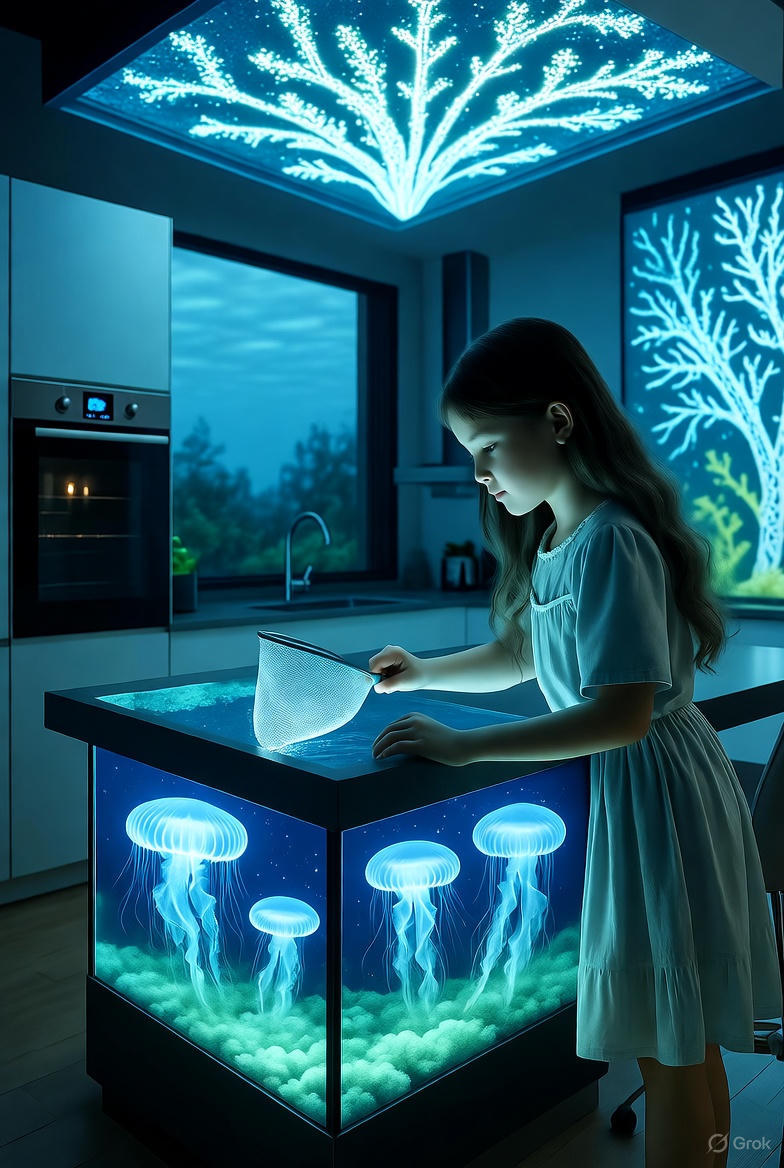
Lyra, with her small, nimble fingers, was performing the delicate ritual of seeding a new bloom. This wasn’t just a chore; it was a science, passed down from her grandmother, a vital part of their family’s survival and comfort. Her task today was to introduce a fresh batch of polyp clones into the main tank, ensuring a continuous cycle of light production.
Beside her, a smaller, clear container held the nascent life: minuscule, almost invisible polyps clinging to a ceramic lattice. With a specially designed, wide-mouthed pipette, Lyra carefully siphoned a nutrient-rich solution containing the tiny, developing jellies. She released them gently into the main tank, watching as they drifted downwards, seeking purchase on the established substrate.
“You have to be patient, little ones,” she whispered, her voice soft against the gurgle of the aeration pump. “Grow strong. Your light keeps us safe.”
The family didn’t kill the jellyfish for their light. Instead, the Lumen Jellies had been bred to periodically release microscopic, light-emitting proteins – a natural overflow of their bioluminescent capabilities – into the tank’s water. Every few weeks, Lyra’s father would use a fine-mesh filter to collect this luminescent protein solution.
This solution, once harvested, would be carefully mixed with a sterile biogel – a clear, nutrient-rich medium designed to keep the proteins active and glowing. With specialized brushes, her mother would then apply this shimmering biogel to the family’s lumen-lined walls. These walls weren’t painted; they were embedded with a subtle, porous matrix that absorbed and held the biogel, allowing it to slowly release its gentle, living light for days or even weeks.
The effect was utterly transformative. The walls of their home glowed with a dynamic, living luminescence, stronger in some patches, softer in others, mimicking the natural ebb and flow of moonlight through leaves. It cast no harsh shadows, but rather diffused everything in a soft, welcoming embrace. Reading by the kitchen’s warm hum, or gathering for dinner under the bedroom’s more subdued shimmer, was an experience steeped in connection – to the living organisms that provided their light, and to a resourceful humanity that had found beauty in scarcity.
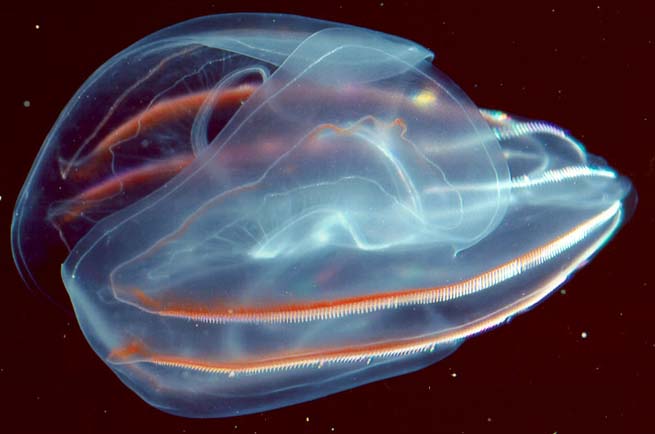
Outside, the roadways glowed, the lanes lined in a bluish-green glow, where cars run on biofuel roll silently, their autonomous tech using the gridlines to keep everyone safe and in their lanes. Along the roads were homes, their light gardens shimmering like the combs of Ctenophores, the windows emanating a soft light keeping the skies above so clear comments could be seen with the naked eye.

Not far away, in the underbelly of urban life, an encrypted black market deals in pure, stolen luciferin precursors. These aren’t for novelty; they are the chemical fuel for the forbidden Chromatic Strains—genetically engineered organisms that pulse with colors tied directly to the owner’s mood or the hour of the day. Here, the predatory live vicariously through the consciousness of others.
Transactions are strictly off-grid, settled with untraceable crypto, shielding the identity of the wealthy elite who fund this obsession. Like the rarest, cutthroat orchid hunts of the 1920s, these living lights are the ultimate status symbol, signaling wealth and access to restricted tech. They are the new darlings, dazzling and deadly, and securing a unique, stable strain is genuinely worth killing for.
It is estimated that 12% – 15% of the electricity produced on this planet goes to lighting. Think about that. We can keep rolling out solar panels that collect sunlight, convert it into direct current where it is passed onto Inverters that feed the grid and……. well…. turn electricity back into light. Why not just cut out the middle man and create art. Bioluminescence is chemiluminescence — light produced by a chemical reaction inside an organism.. No sunlight is needed. The light comes from a reaction between:
- Luciferin – the light-producing molecule
- Luciferase – the enzyme that catalyzes the reaction
- Oxygen – which reacts with luciferin to emit photons
Is it possible we are blind to everything? To what we have and haven’t had to think about it. What if we could tap trees for solar energy? They would be the land analog of bioluminescent creatures — living organisms as light factories. Going from Photosynthesis (Capturing light) to Bioluminescence (Creating light) to Bioelectricity (Transducing light into current). If we could do this, think of how humans would, once again, see forests or a single tree.
The Efficiency
Bioluminescent reactions are astonishingly efficient — up to 90% of the energy goes into light, not heat. Compare that to a candle or incandescent bulb, which wastes ~95% as heat.
About the author: David Nadas – “Where Science meets Storytelling”
Growing up at the Jersey Shore, summer nights were pure magic. The air was still and the dark water surface looked like a mirror, reflecting the stars above. As our 14′ outboard glided out through the canals and the Manasquan Inlet to the ocean, the reflection created an illusion of being suspended in space–– stars both above and below our hull. We positioned ourselves just far enough out to still see the distant glow of oceanfront homes and the kaleidoscope of colors from the boardwalk amusement park. Jumping into the water was the final thrill: every kick and arm movement set off a brilliant flash of bioluminescence from the plankton, igniting the water like heat lightning. These experiences were what led me to study Marine Sciences and my fascination of bioluminescence has never faded.

 David Nadas