Understanding Solar Flares and Coronal Mass Ejections
Reply


QUESTION: Solar flare is to Coronal Mass Ejection (CME) as:
A: Dog is to cat.
B. Muzzle flash is to cannonball.
C. Bow is to arrow.
D. All of the above
E. None of the above
ANSWER: B – Muzzle flash is to cannonball.
Pretty sure this wasn’t on the SATs, but one thing is certain: Earth—along with its inner sister planets—has been a cosmic clay pigeon for billions of years.
Every year, new technology uncovers more about how our Sun works—yet the deeper we look, the more we realize some mysteries are better off unsolved. It’s like turning the doorknob on a room that’s been sealed for as long as you can remember. You take a regretful breath, flick on the light, and face a swarm of flaming bats heading straight for you. But here’s the real threat: it’s when you don’t see the bats coming, that’s when the bats are coming.
Our Sun (Sol) is like that room: But we’re not talking bats and fire. Imagine an unbroken, self-sustaining thermonuclear detonation where anything that is anything is being torn to subatomic pieces, burning at 27 million degrees Fahrenheit. Millions of nuclear warheads detonating simultaneously, without end, for billions of years.
There are many religions, both ancient and modern, which hold our sun as a central figure–– and for good reason–– Sol is both our keeper and our destroyer.
But every now and then, through the ebb and flow of solar cycles, which last approximately 11 years each, our Sun reaches her hand across the vastness to caress us. A show of love and beauty, reminding Earth is her child. This display comes in the form of Solar Flares and Coronal Mass Ejections (CME). But it is the CME–– a cloud of physical solar matter (plasma and magnetic fields) thrown into space by a solar flare (mussel flash) reaching our eyes eight minutes later, while the CME (canon ball) can take three or four days. When a CME reaches Earth, it causes geomagnetic storms in the atmosphere–– those spectacular aurorae. The colors of the aurorae are determined by two main factors: the chemical gases in the atmosphere (oxygen, nitrogen) and the altitude of those interactions.
The Carrington Event was the most intense CME to collide with Earth ever recorded, occurring in 1859, September 1st through 2nd during Solar Cycle 10. So intense was the CME that when the plasma and magnetic radiation reached Earth, it upended the telegraph stations, sending charged particles along the wires, shocking the telegraph operators, and in some cases catching the paper on fire. The auroras from that CME were seen as far as South America and Australia.
A more recent, but not nearly as powerful as the CME of 1859, occurred in 1989, affecting Hydro-Québec’s electricity transmission system. The Auroras from that CME were seen as far south as Texas and Florida, some call-in to local officials panicing that a nuclear war had broken out.
If a Carrington-level CME struck Earth today, the sudden distortion of our magnetosphere would induce direct current (DC) into long-distance, high-voltage transmission lines. This surge would quickly saturate extra-high-voltage (EHV) transformers—leading to catastrophic core overheating, widespread grid collapse, and permanent equipment destruction in a matter of seconds.These transformers are custom built, weigh several hundred tonnes and have a manufacturing lead time in months. it would leave cities and communities in darkness for extended periods of time.
Beyond the immediate failure of the power grid, the secondary fallout of a Carrington-level CME would cascade across virtually every layer of modern infrastructure. While a CME differs fundamentally from a high-altitude Electromagnetic Pulse (EMP), its indirect consequences would be far-reaching.
Modern society relies on a continuous supply of electricity to maintain basic life-support utilities. A prolonged, multi-region grid failure would trigger immediate operational collapses:
The geomagnetic disturbance extends far above Earth’s surface, impacting space-based assets and global connectivity:
A common misconception is that a solar storm will destroy unpowered personal electronics, such as smartphones, laptops, or modern cars. This stems from confusing a Coronal Mass Ejection (CME) with a High-Altitude Nuclear Electromagnetic Pulse (HEMP).
The Reality for Personal Devices: Your smartphone, laptop, or car would physically survive a CME completely unharmed. However, without cell towers, internet backbones, functional GPS constellations, or a working power grid to recharge them, those personal electronics would effectively be rendered useless bricks.
Maybe not knowing what is heading our way is bliss, but If you still wish to open that door and turn on the light, then sign up on a good space weather app to get alerts. I chose to use NOAA’s Space Weather Prediction Center. A typical alert looks like this: (see below: This was from Nov. 4th, 2021… now, as of this writing). This is a G3, K-index of 7….. considered strong and likely to disrupt HF radio and some navigation. The lucky ones might be able to see an Aurora
Aurora may be seen as low as Pennsylvania to Iowa to Oregon.
.
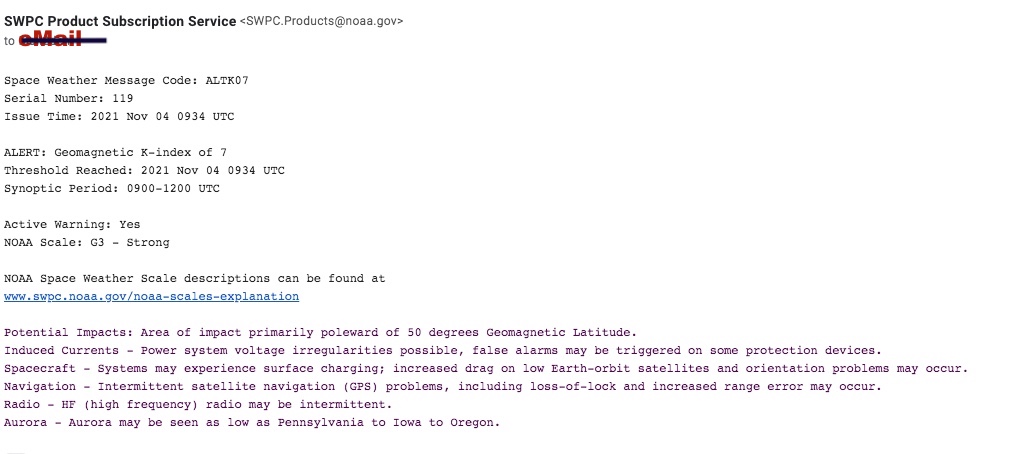
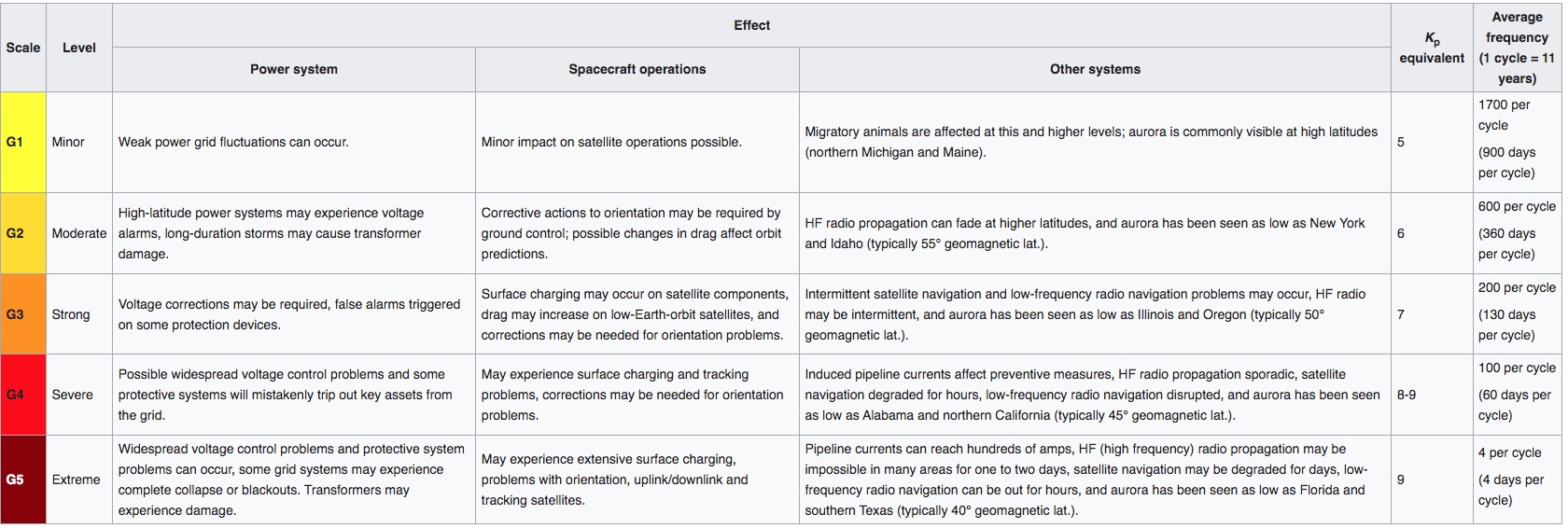
To aid you in what the K-index, NOAA Scale and horizontal Geomagnetic latitude are: use these charts:

Was Mars an unlucky clay pigeon? Maybe one day we will find out.
Between tracking CMEs, EMP threats, and the lingering nightmare of a laboratory-engineered pathogen, my focus keeps drifting from fictional world-building to real-world survival prep. Investing in a DIY portable solar generator and dialing in a functional 72-hour bug-out bag isn’t paranoia—it’s practical insurance. Still, I’m holding out hope that these scenarios remain strictly within the realm of science fiction.