Im writing this open letter as someone who holds the utmost respect for your contributions to humanity. Your vision and drive have undeniably pushed the boundaries of what many thought impossible, from revolutionizing space travel to accelerating the transition to sustainable energy.
However, I feel compelled to express a growing concern that you may be losing your way. My concern centers on your focus, or rather, what appears to be a diffusion of it. While I understand your concern with the exorbitant waste in government— it is an issue and counterproductive to D.O.G.E.— and that you’ve always maintained a stance of speaking your mind, even if it impacts stock performance and indeed, as an individual investor, I have the choice to divest, it’s important to remember that not all investors share that same flexibility.
Many individuals are invested in your companies through their 401(k)s or pension plans and they are drawing monthly from these plans in retirement. These are often long-term investments, foundational to THEIR financial security, and the individuals behind them don’t have the immediate option to pull out simply because of public statements or perceived distractions.
You may not think you do, but you owe these investors your dedicated focus and unwavering attention to the core missions of the companies you’ve built.
My plea is simple: let go of the perceived “foolishness” and rededicate your formidable intellect and drive to delivering the future through your businesses. The world fell in love with you and needs the innovation and progress that your companies are capable of.
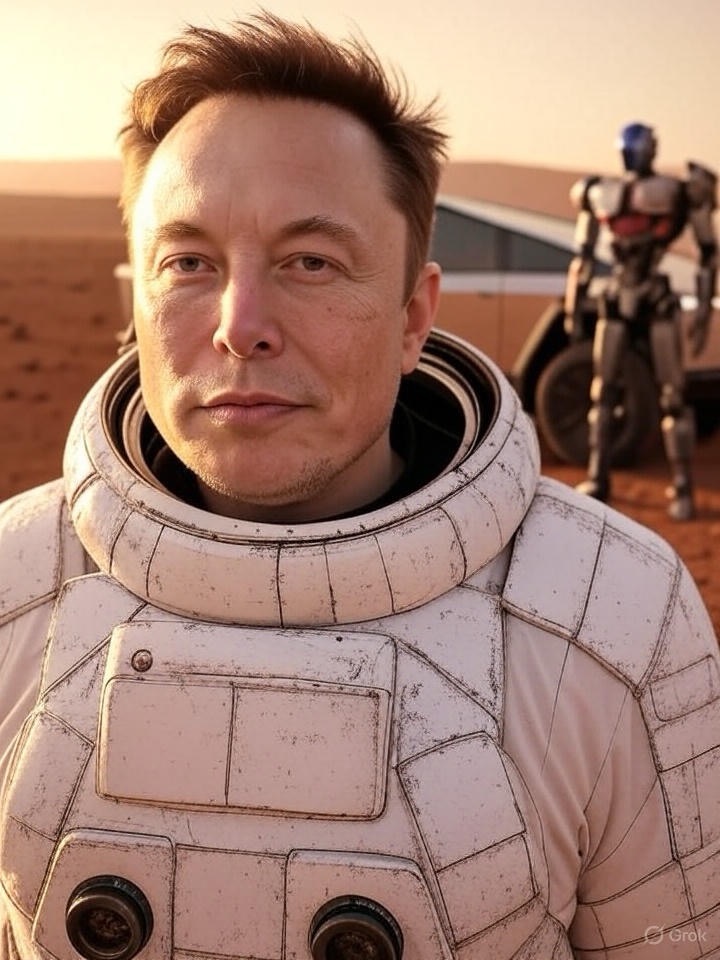
Please apply that focus to them.Get us to Mars. And after that, who cares.
When President John F. Kennedy stood before the nation in 1962 and declared that we would go to the Moon—not because it was easy, but because it was hard—he lit a fire that carried a generation into the stars. It was bold. Audacious. A promise that seemed impossible… until it wasn’t. Today, that spirit is alive again—but this time, it’s not coming from the Oval Office. It’s rising from the dust at Starbase Texas with Elon Musk.
As a kid, I’d lie in bed with a flashlight tucked under the covers, devouring Sci-Fi Pulp Fiction novellas long past bedtime. Back then, those glowing pages were portals—each word a beam of light teleporting visions straight into my mind. I saw moon bases, rocket ports, and human settlements scattered across the solar system. Those futures felt far-off but inevitable—like watching the first glint of dawn and knowing full daylight would follow. Not knowing then, I realized later that science Fiction is fact waiting to happen.
Now, that imagined future is solidifying into steel and launch pads on the Gulf Coast. Starbase, Texas—once a stretch of quiet shoreline—is transforming into the first entirely new city in decades, and more than that, it’s becoming the cradle of space colonization. Not just another launch site, but a functional city with its eyes pointed skyward. What once was fiction whispered to a child by flashlight is now a blueprint being built in daylight.
Most Americans haven’t quite absorbed this shift yet. The scale of it—what it means to have regular rockets, self-landing boosters, orbital refueling, and crews preparing to build on other worlds—still hovers just outside the public consciousness. But make no mistake: history will point to this moment and say, this is when it began. Not with flags planted in dust, but with concrete poured Texas and Florida, with dreams launched on reusable wings.
And Elon has managed to develop what feels like alien technology—without raiding the vaults of Area 51 or unsealing some forgotten Pentagon file. No secret spacecraft reverse-engineered from crash sites. No whispered hand-me-downs from shadowy defense contractors. Just the sheer force of vision, engineering, and iteration. It’s almost more unbelievable that way.
What we’re witnessing isn’t the result of hidden knowledge—it’s the result of someone who seems to think like an alien. A mind unbound by convention. While the aerospace establishment took baby steps, Elon sprinted past them, leapfrogging entire generations of tech. He didn’t wait for permission. He didn’t wait for NASA to go first. He moved fast, broke what needed breaking, and built a new space industry from the molten core of ambition.
In a way, Elon is our own alien developer—not from another planet, but from another mindset. He didn’t arrive in a saucer; he arrived with software updates and stainless steel prototypes. He doesn’t hide behind secrecy—he invites the world to watch. He tweets engineering problems. He launches Starships like we used to launch dreams.
The spacecraft we imagined hidden away in desert bunkers? He’s landing them upright on drone ships, catching them with chopsticks, naming them after science fiction AIs, and prepping them for Mars. And doing it all in plain sight.
Starbase, Texas, is not the endgame—it’s the launchpad for a civilization becoming interplanetary. A century from now, schoolchildren might look back and say: It didn’t come from aliens. It came from us. From a man who thought like no one else, and dared to build the future while the rest of the world waited for it to arrive.
This should be the most important 40 minutes shown in every classroom—a powerful antidote to the scrolling addiction that’s hijacking a generation’s focus, purpose, and potential.
Space X or Blue Origin are said to dominate the Space Tourism Industry, but if you bet on their approach then you will loose.
Understanding Mr. Rubinstein’s philosophy is why Apple dominated the smartphone market and why Microsoft failed.
Would you rather be sitting above a cylinder that is exploding below you for a brain rattling ride straight up into space or take your time to climb to 45,000 ft, then rocket much more smoothly for 40 seconds and glide though space before heading back back down to Earth in comfort? There is one thing Richard Branson understands and that is Tourism. He has brought the future to the present.

 David Nadas