On the morning of 9/11, I was working as a senior technologist on the trading floor for a global bank in downtown Manhattan. This isn’t a retelling of what I witnessed that day but rather a reflection on something that profoundly affected me five days later.
Exiting the subway car at Fulton Street I was skip-breathing, trying to avoid the gritty, acrid smoke that clung to the back of my throat. At street level, I was once again directed into a security checkpoint manned by military personnel, each looked prepared for combat, the strap of their automatic weapon slung ready over their shoulder and their finger resting comfortably along the trigger guard. They scrutinized our faces, matching them to our driver’s licenses, and inquired about our purpose, cross-referencing our answers to the building IDs that hung from lanyards around our neck. Despite the intense scrutiny, I thanked them for making me feel safe and with a simple nod I was cleared to proceed.
With the sun in my eyes, I made my way eastward along Fulton Street until I could turn south onto Nassau and disappear into the shadows. As of late, It was eerily quiet, an unusual state for this bustling artery of commerce. Still no car horns blaring, no alarms or sirens wailing, no helicopter blades chopping through the air above, no fluttering of pigeons, no rush of bicycles darting about with urgent document deliveries, and no clamor of street vendors jockeying their carts into position, prepared to serve up hot coffee, buttered rolls, and warm bagels.
As I approached Liberty Street prepared to once again head east into the sun, I came to a halt seeing a shaft of light filled with glittering specs, like tiny mirrors, which I knew were pieces of the towers and everyone who were trapped within. I knew that each tiny mirror held the face of a soul lost that morning on 9/11. As if pierced by some other consciousness, a poem began to stream through me. Having had nothing to write on, I committed each line to memory, but I could feel this thing—this stream begin to fade.
Rushing into my building, ignoring my colleagues, I rode the elevator to the 16th floor, my lips silently repeating each line, now beginning to tangle in memory. When the doors opened, I sprinted into my office, where I wrote down as fast as I could recall on the back of a document I had printed out the day before. The words and lines below are exactly what came to me—no edits.
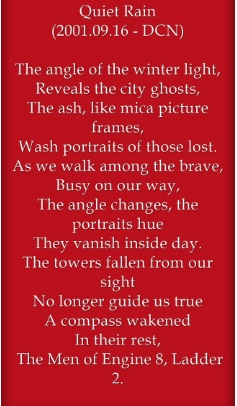
Engine 8, Ladder 2 was in my local precinct where my wife and I lived in Midtown. That day I delivered several copies to this poem to my precinct and gave my condolences to those brave men and women who I met.
I had often wondered why or how that poem came to me out of thin air. Then, some ten years later, I stumbled upon a TED Talk by Elizabeth Gilbert (author of “Eat, Prey, Love”), titled “Your Elusive Creative Genius.” She described exactly what I experienced, but to a fellow friend of hers, a poet, who experienced the same phenomenon while picking flowers in a field. If you get a chance, view and listen to Elizabeth’s TED lecture. It was a life-changing experience for me, especially as a writer. Life is full of mysteries, and it rewards us now and then with some of those mysteries, explained.
 David Nadas