The Dancing Plague of 1518 was perhaps the most famous social contagion in history. It occurred in Strasbourg, Alsace (then part of the Holy Roman Empire). A woman named Frau Troffea stepped into the street and began to dance fanatically. She couldn’t stop and for days some 400 people had joined her. Dancing until they collapsed from exhaustion or died of heart attacks and strokes. Local authorities, mistakenly believing the afflicted just needed to dance it out, built a wooden stage and hired musicians, fueling a fire already burning.
In the 1630’s, another social contagion known as The Tulip Mania, saw the contract prices for bulbs of the newly introduced tulip reach extraordinarily high levels. At the peak, a single bulb could cost more than a luxurious home. It wasn’t just merchants caught up in this, it swept through all social strata netting everyone–– people selling land and life savings to participate in the market. By 1637, the bubble burst when buyers simply stopped showing up to auctions, leading to a massive social and financial panic. This may have been the first meme stock.
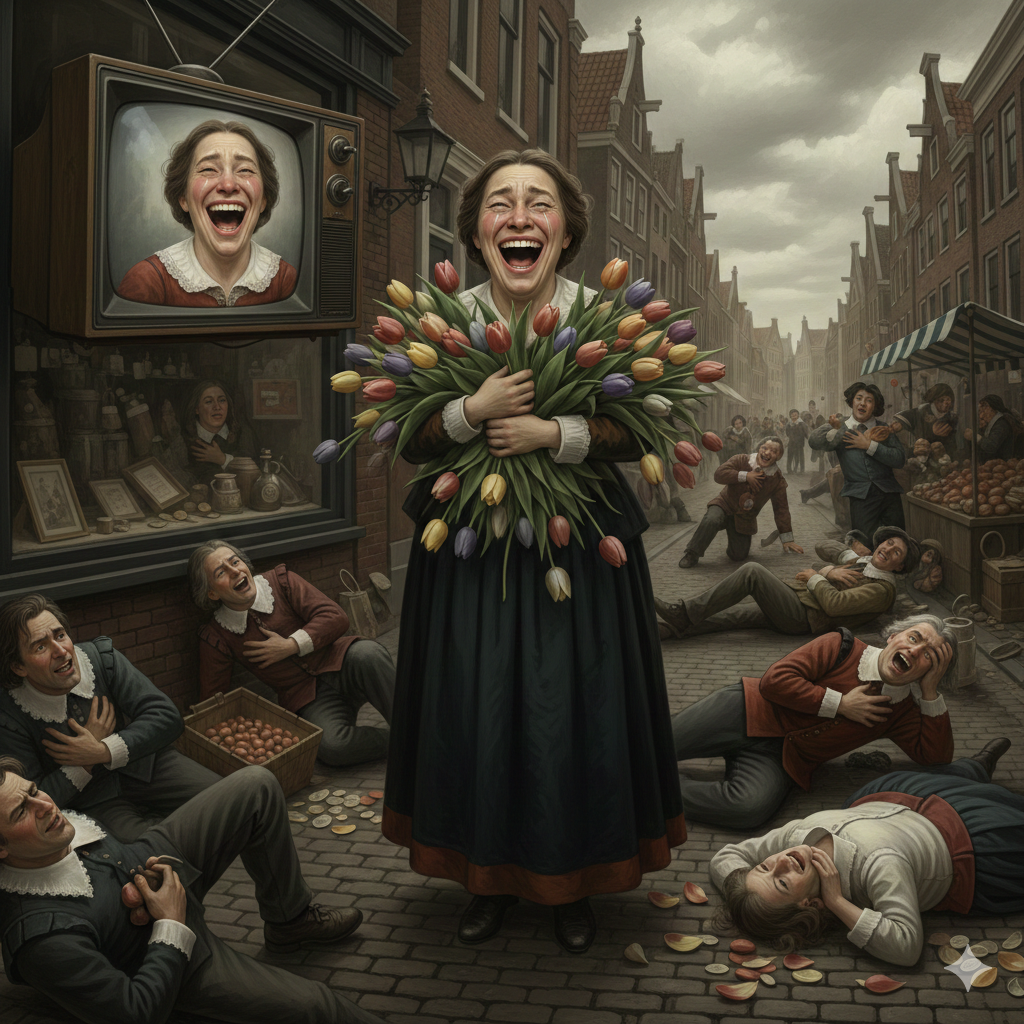
Jump to 1962 and the Tanganyika Laughing Epidemic in now Tanzania. This was one of the most surreal and well-documented cases of Mass Psychogenic Illness (MPI). On January 30, 1962, at a mission-run boarding school for girls in the village of Kashasha, students began to laugh uncontrollably. In the weeks that followed the MPI spread to 95 or the 159 students, causing the school to shut down because the students could not concentrate on their studies. When the girls were sent home, they carried the behavior to their villages, sparking new outbreaks in 14 other schools and affecting roughly 1,000 people. The victims weren’t exhibiting happiness, and in fact, these symptoms were physically exhausting, inducing fainting, crying, rash outbreaks and respiratory issues, lasting from hours to weeks.
As a technologist and former marine biologist, I’ve spent my career studying the depth and complexity of both digital and ecological systems. I subscribe to Barry Commoner’s four rules of Ecology, his first rule becoming a personal directive of mine: “Everything is connected to everything else. Understanding how these frameworks interact, I find the “TikTok Tics” phenomenon to be one of the most morbidly fascinating examples of social contagions of modern times–– induced by technology. The phenomenon known as “TikTok Tics“ refers to a sudden surge in functional tic-like behaviors (FTLB) that emerged globally during the COVID-19 pandemic, specifically between 2020 and 2021. At that time, there had been a surge in young women exhibiting Tourette’s-like tics during the pandemic. Tourette’s usually begins in childhood and is about four times more common in young males, but the global onset of tics in young women was sudden and explosive with a rapid progression of motor and vocal tics. The vector behind this occurred when school closures and forced social isolation, turned teenagers spending unprecedented amounts of time on TikTok.
Along comes Eve–– the fuel and conduit.
As a writer of sci-fi, I explore new plots in short treatments — like throwing spaghetti at a wall to see if it sticks. Well, one of my treatments is titled, (5)Tream … as in Stream… a techSocial virus that takes only 5 seconds of listening for a person to become induced in a short-term coma. This idea was spawned by a fusion of a digital virus in the classic Sci-Fi novel, Snow Crash by Neal Stephenson and Monty python’s skit of “The funniest joke in the world.” iterations of social contagions which have existed throughout history.
The “Pebble in the Pond” Effect
Is it possible that our civil polarization isn’t necessarily a series of unique, intentional conflicts, but rather a a mechanical reaction to a kinetic chain. Take a single pebble thrown into a pond. Once that pebble hits, the ripples are inevitable. We react to the reaction of the reaction. By the time we reach the outer rings, we’ve forgotten what the “pebble” even was; we’re just bobbing in the chop. That initial splash could be a single event—a piece of legislation, a viral video, a technological shift (like the birth of the algorithm), or a mutation of initiative to boost advertising gone addictive. We just witnessed the outcome of the Meta/Google lawsuit (P.F., et al. (K.G.M.) v. Meta Platforms, Inc., et al.) brought on by the plaintiff K. G.M. — our modern day Frau Troffea.
 David Nadas
Leave a comment