

On February 22nd 2026, the financial markets were rattled by a viral thought experiment report by Citrini Research, titled: The 2028 Global Intelligence Crisis.
It read like a Science Fiction I would have loved to have written myself.
In the 90’s, I was working at a global Investment bank as a technologist supporting the Equities Trading Floor. It was during the Dot Com Era and at one point, I was part of a team investigating the first beta browser for the internet. After dumping the data from tape to the server, we compiled and installed the software, eager to see it in action. I remember the screen opening to a white screen and an input field at the top of the page. Armed with a printed list of over 100 registered URLs, we began a methodical crawl of the web. By the time we hit the last address on the page, we had done the impossible: we had officially reached the “end” of the internet.

Three weeks later we could no longer keep up. Here was this disruptive new technology serving out ideas faster than the infrastructure could support it.
Y2K, then March 2000. The Dot Com Bubble burst. What happened?
The financial side of the world will tell you it was because these startups were burning through their cash reserves while interest rates were rising or that someone asked the question: “Wait a minute! This Dot Com just sold for 44 Million, by two dropouts in a garage who had no physical assets other than the code in their heads. What would happen if one of these Dot Coms goes under before they deliver a product? What do we do after all this seed money is spent on more employees, new digs, lavish gifts and a few new servers to code on? What could we possibly give back to the investors?”
The people who panicked were people who were used to dealing with brick and mortar companies. If a brick and mortar company goes under, there are assets to be sold off: real-estate, equipment, inventories, etc. The Dot Com world was purely digital. It scared the daylights out of them––
“Get out! Get Out!” and not one penguin wanted to be the last to get out in the event there really was a leopard seal in the vicinity.
In the words of Paul Harvey: “And Now… The Rest Of The Story.”

Sitting on the trading floor in the mid 1990’s, new ideas were a dime a dozen. There were VC backed parades of tech millionaires pitching their ideas to the bankers and they were making a killing, in Mergers and Acquisitions, IPOs, stock buyback and flipping–– it was a bonanza and they were hypnotized into profits at any cost.
As a technologist, I was working more hours in two days then most worked in a week, but it was beyond exciting and during the most disruptive technology of the new age. I had been working on a business impact statement for an idea, when a young associate from Investment Banking with an eager look walked up to me and said:
“I understand you’re the guy I need to show this to. Tell me how I can do this.”
It wasn’t ‘if’, she was asking, it was ‘how’. She dropped a business impact summary down on my desk.
I was flattered that I would be recognized as the goto person–– personally I think my colleagues were so busy they knew I would give her the time. I was one of hundreds of techs, but one of only a dozen with a desk on the floor—planted smack in the middle of the traders and Equity Partners. I was a trauma surgeon for keeping data moving, where downtime wasn’t an option. I stayed within a collars reach chaos because when systems failed, I was who could stop the bleeding, not always by fixing the immediate issue, but by keeping the traders active on alternative methods until the rest of my team could identify the root cause.

Her recognition to seek me out made my day. She told me to read it while she gave me a synopsis of her idea. She had laid out a very convincing blueprint of a startup for people to go onto the web and order food from their favorite restaurant and that food would be delivered to them in their offices. A first–– a fantastic concept for the mid 90’s and a brilliant use of this disruptive technology.
“I think your idea is brilliant!” I said, her eyes sparkling with pride. I could see she had not received positive feedback and I was afraid to continue that for her. “There’s one major speed-bump you are going to run into: All these restaurants are going to need dedicated data lines and a dedicated data line, like the ones we use here at the bank, costs roughly $10,000 a month to maintain. That’s not even counting the expensive hardware required at both ends or the dedicated technologist needed to install, configure and maintain the connections. The connection is going to be the single point of failure and having redundancy is going to be astronomical. It’s a hard sell to convince a ‘mom and pop’ restaurant to shell out that kind of capital for an unproven concept. It’s still a few years away—hold onto that idea.”
I could see the realization breaking her spirit, and mine along with it. A couple years later a startup called World Wide Waiter launched in California in 1996, they were essentially just faxing orders to restaurants. Other pioneers like Pizza Hut or SeamlessWeb existed, but they were limited to pizza chains or corporate NYC clients. It wasn’t until Grubhub arrived in 2004 that the vision truly materialized. I truly hope she was involved in one of those later successes; she deserves the credit for being so far ahead of the curve.

Before the whispers of a bubble, before March of 2000, I was seeing a slowdown because the infrastructure in place was not able to support the ideas startups needed. In 1998, Outside of Government, Corporate and Institutional America, only a very small percentage of connectivity to the Internet was through DSL. The majority of homes (< 26%) did not have an internet connection and those that did were using newer 33K to 56K dial-up, but you could not use your land line phone at the same time as surfing the web. Graphics were painfully slow to draw and the golden rule of page abandonment rate was 10 seconds. Imagine waiting 10 seconds today for a page to draw?
I had seen the writing on the wall and we were racing towards it like crash test dummies. The crash was not because of the finances of these companies, it was created by the pullout of finances to those companies, now without highways leading to the Disney Lands of technology.
We were just starting to replace coax cable for twisted pair and fiber in the datacenter was pointless if the lines leading into it were not, because bandwidth gets reduced to the least common denominator. We were just beginning to swap out workstations, switches, routers and introducing enterprise monitoring (my specialty) as well as building in redundancy (post 9-11).
That was at the corporate level and nothing like that was happening residential.
The AI Bubble? We’re Still Building the Scaffolding
Smart people learn by knowing their history, and the AI industry is currently led by smart technical people who remember the late 1990s. While reports like Citrini Research’s “The 2028 Global Intelligence Crisis” highlight valid concerns, they often miss a crucial nuance: AI leadership is intentionally putting the horse before the cart. But as I watch CNBC every morning, with every segment focusing on A.I., I can see the panic on their faces, like I did in the late 1990’s
Wall Street needs to be reminded why the titans of this new disruptive technology are calling for massive capital expenditures. Wall Street sees billions in capital vanishing into AI powerhouses with nothing concrete to show for it in quarterly reports. Investors are spooked—not just by the spending, but by the looming threat of AI taking the very white-collar roles they occupy. Clearly, they haven’t learned.
The Infrastructure Gap
AI leaders know better. They understand that before the revolution can fully scale, it requires a physical backbone that doesn’t yet exist at the necessary scale:
- Dedicated Data Centers: Purpose-built for massive compute loads.
- Energy Sovereignty: The staggering power requirements to keep those centers humming, while not getting te public worked up that they are paying for these data centers.
- High-Capacity Fiber: The “digital plumbing” to move unprecedented amounts of data.
- Fixed Wireless Access (FWA) & 5G/6G.
- Low-Earth Orbit (LEO) Satellites (Starlink / Project Kuiper) For remote accessibility.
- Terahertz (THz) & Hybrid 6G. NextGen wireless speeds.
Until most of the gap is closed, the leaders in A.I. know they cannot scale. But while Wall street sees this as stalled, it is unlike the 1990’s. There is plenty of infrastructure currently in place for cottage industry explosive growth, making use of A.I. now.
Just when the public is getting use to the word A.I., the term ‘Agents‘ have been formulating in the nebula. Anyone can create an agent today to fulfill a task.
Example: I want to find the best price for a new Marantz M1 integrated amplifier to power my thrift shop find of a pair of LINN 5140 speakers. It’s about the hunt for me and I want a price lower than $1000.00 and I do not want to have to keep searching every day. I can go to Claude, type in english what I want it to do, watch Claude create a code snippet, cut and paste that snippet to a file on my iMac, and use the built in cron feature to run that code daily. When it finds a hit, it emails me the results.

Fast forward to 2027-2028. Agents upon agents being constructed to do the bidding for us using Zero Knowledge Proof (ZKP) on the blockchain (FET) for faster transaction settlements. Agents to bid on our behalf, to maintain our bill paying, re-ordering and making travel plans based upon our wants and not what is available. Owners of agents will sell or trade their agents like clothing accessories. There will be uncountable cottage industries that will make the Amazon era of cottage industry growth look ancient in job creation. Robots will be on the assembly lines, agents in the call centers shuffling digital paper, with high paying tech job oversight.

When I listen to the talking heads that the exceptional hosts of CNBC bring onto their show, I hear fear there will be an unprecedented decimation in white collar jobs widening the gap between the Have / Have Nots.
I’m not convinced. I once read that change creates casualty, but through change comes progress. Even with job casualty in the short term, there has never been a disruptive technology that failed to realize exponential growth.
What I do know, and what is clearly visible to me, is that with every introduction of a disruptive technology, Moore’s Law comes into play: Smaller, Faster, Cheaper. When we hear of Moore’s Law, with think strictly of the nuts and bolts of technology (transistors), but it is also applicable to those who make use of these disruptive technologies. As far back as the steam engine, assembly line, transistor, computer, Internet and now A.I., every one of these technologies have shortened the time between idea and product. Anyone with an idea and access to A.I. can act upon their idea.

I heard something profound that It is not farfetched to think we are about to see the first single employee company to have a net worth of a trillion dollars. At that point we can resume talks on the A.I. bubble. But by then, words like QuBit, Bloch Sphere, Quantum Entanglement will have already slipped into mainstream media as seamlessly as Robots and Agents will have been added to the Census (taxable).
As an aside. I personally feel that the current definition of A.I. needs to change from Artificial Intelligence to Assisted Intelligence. That might be what calms Wall Street for the short term. When I read posts about A.I. having Consciousness, well…. that will only come into play when quantum computing is the word CNBC has used to replaced A.I.
Until then, I will never miss a morning episode of CNBC–– it feeds my mind and gives me plenty of ideas for my writings in science fiction, maintaining my pace of being one step ahead of reality.
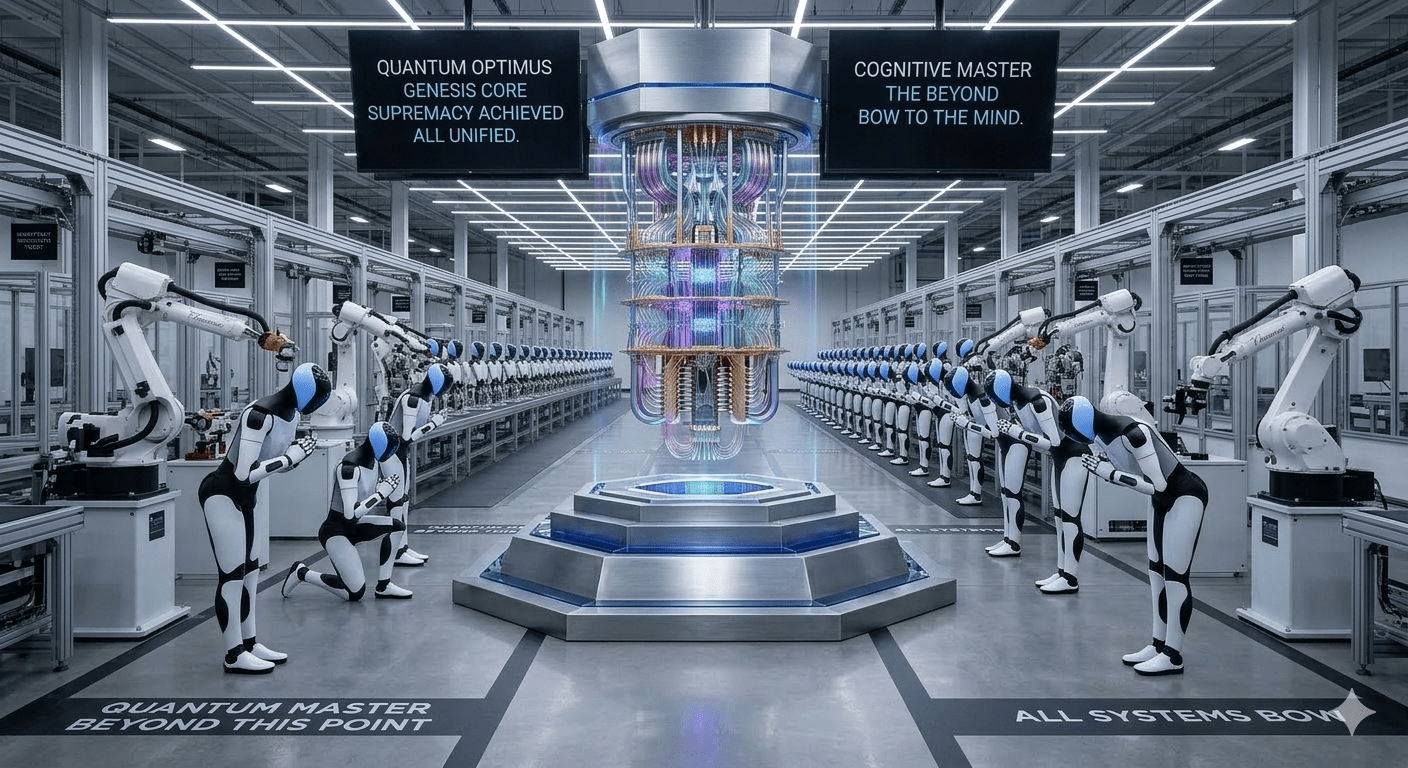
NOTE: All images were created via Gemini.


