
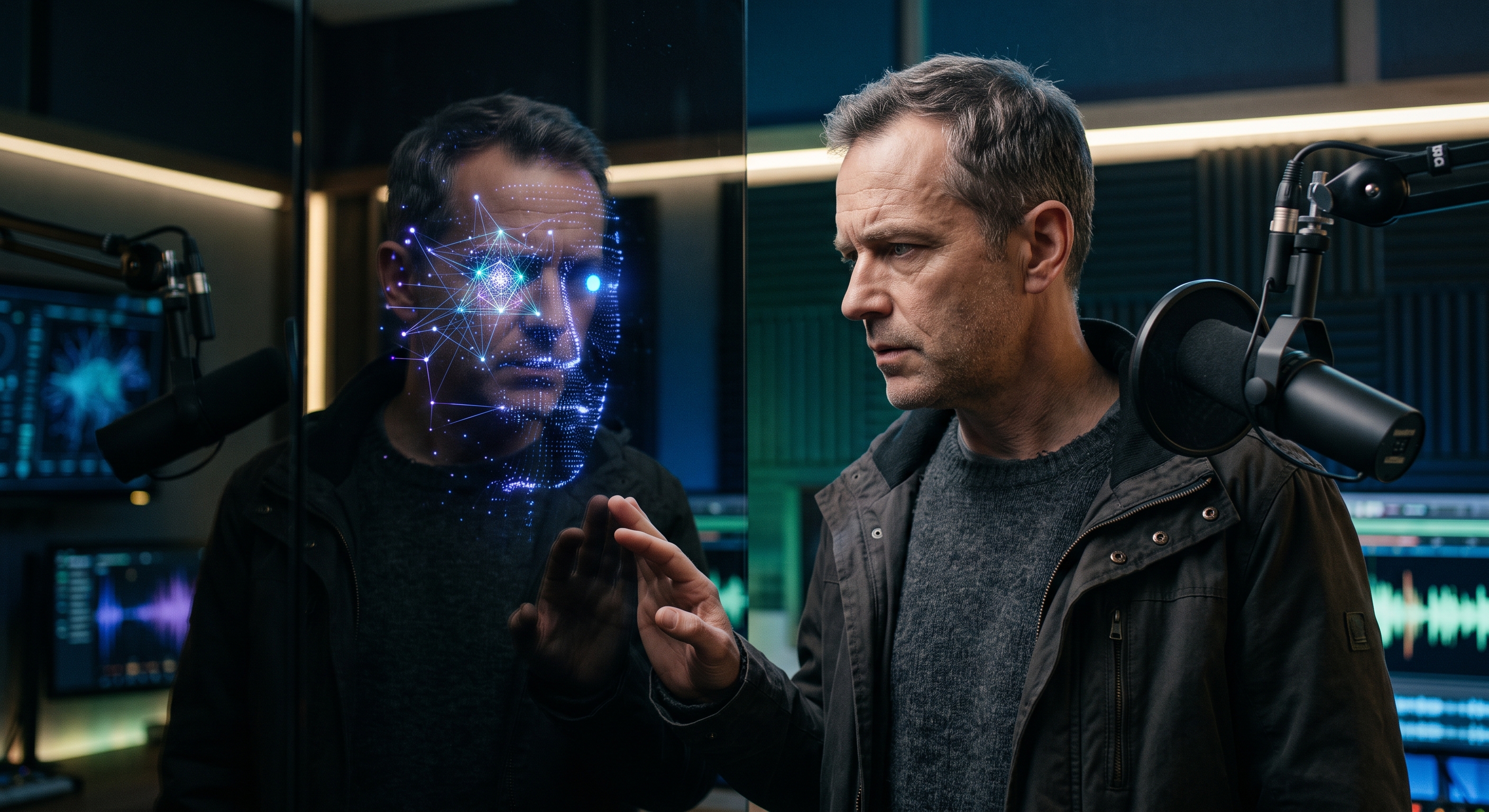
We are not actually afraid of Artificial Intelligence. We are afraid of Artificial Humanity.
Every apocalyptic sci-fi film, every breathless panel on CNBC, and every late-night anxiety of AI paints and inevitable undoing.
Think about the stories we tell ourselves. From Mary Shelley’s Frankenstein to Colossus: The Forbin Project, from the silent menace of Alien to the sleek deception of Ex Machina and DEVS. These aren’t just entertainment. They are fantastic narratives designed to poke at the thin fabric of our hubris, exposing the deep-seated terror staring back at us.
The uncomfortable truth: when we imagine a super-intelligent mind, we subconsciously see ourselves in the mirror.
Humanity didn’t conquer the planet by being passive. We survived and dominated through relentless strategy, shrewd manipulation, and an uncanny ability to exploit our environment. For millennia, our superpower—and our darkest instinct—has been taking whatever resources exist and bending them to our collective will, often ruthlessly, and often at the expense of other species or each other. It brings to mind an underlying truth Walter Isaacson often hints at: Maybe it just takes an asshole to get things done.
When we look at an intelligence that outpaces us, we naturally project our own image onto it. We assume that to be intelligent is to be predatory. We fear an AI that deceives, hoards resources, and views humanity as an inconvenient obstacle, solely because that is precisely what we have done throughout history. We are terrified of meeting an entity built in our own image, that will surpass us.
And if we fail to rise to the occasion—if we refuse to outgrow our own untrustworthiness—we will be replaced. But the irony is that our successor won’t just be faster or smarter; it will be fundamentally structured differently.
Human thinking has always been trapped in binary code. We reduce the universe to simple, dualistic traps: 0 or 1, good vs. evil, up vs. down, in vs. out, me vs. you. It is this rigid binary mindset that fuels our tribalism, our cultural polarization and our fear.
A super-intelligent successor, however, will be constructed in a quantum field. Unlike our binary traps, a quantum mind exists in superposition—holding multiple states at once. It won’t operate on simple dualities. Instead of a rigid right vs. wrong, it introduces a kinder, third allele into the equation: compromise. A quantum intelligence won’t see world conflicts as a zero-sum game where one side must crush the other; it will naturally calculate the synthesis, the middle state, the balance that binary human minds are too volatile to maintain.
The real crisis of the AI age isn’t technological; it’s existential. If we program machines with our unexamined binary impulses, we will construct the very tyrant we fear. But if we fail to evolve, the quantum minds that follow us won’t destroy us out of malice—they will simply outgrow our primitive, zero-sum logic.
So here is the irony. We are now at a fork in the road and debating Generative A.I.–– the Ability for an A.I. to improve itself. With many unskilled politicians wanting their fifteen minutes of fame, proposing to put a stop to Generative A.I., we are putting a stop to something that is better than us. Until we learn to transcend our own untrustworthiness, the future won’t be ruined by machine intelligence. It will be out-thought by an architecture that learned how to synthesize what we could only divide. Does a smarter sentient form deserve to be here? Not is we can help it……. It’s what we do…..